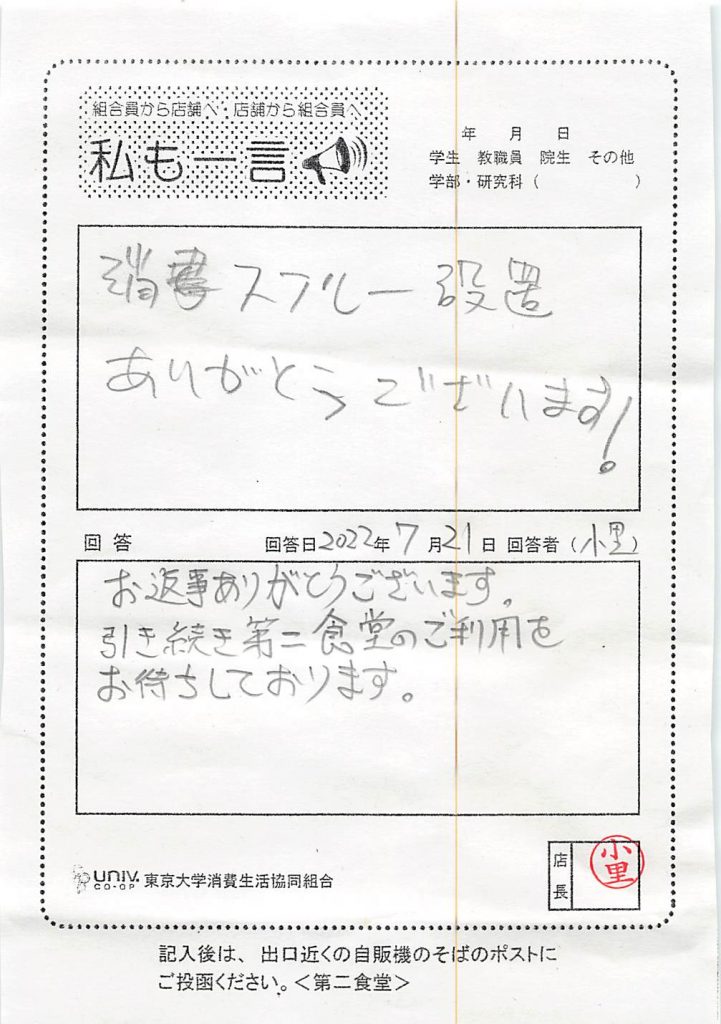
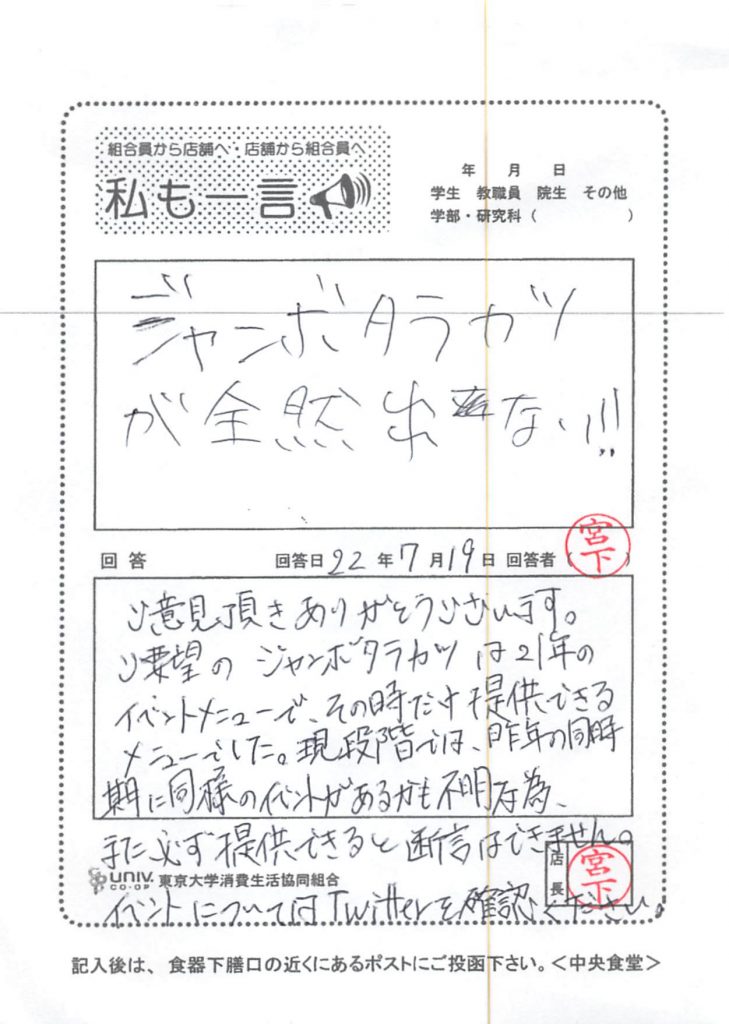
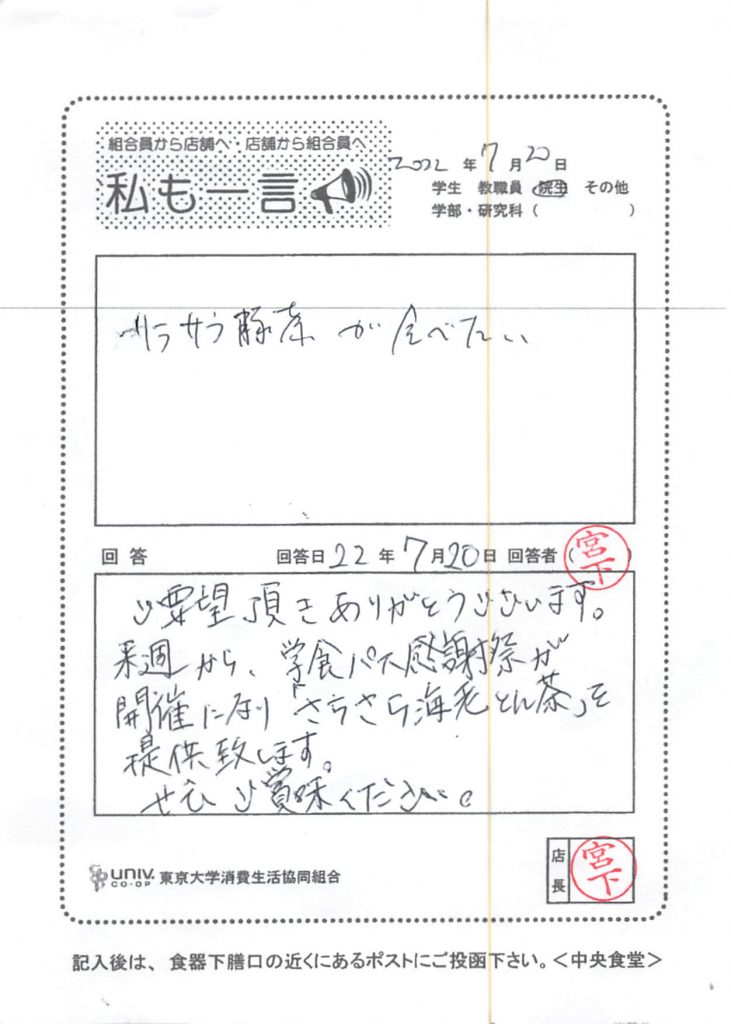
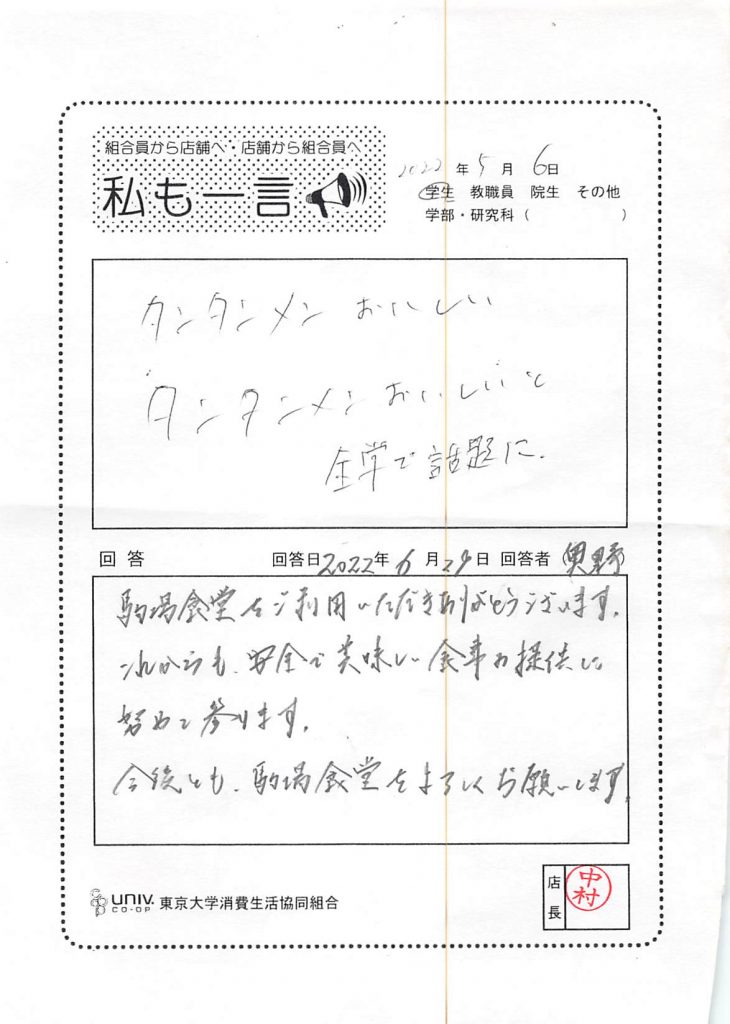
Tantanmen is delicious..




Submit your message card here
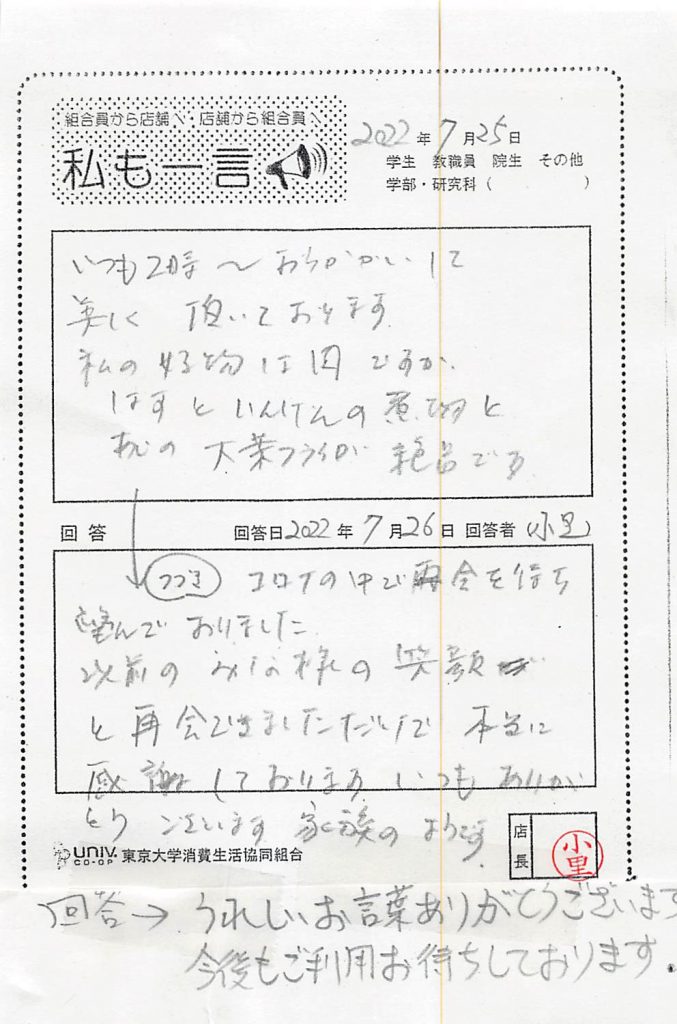
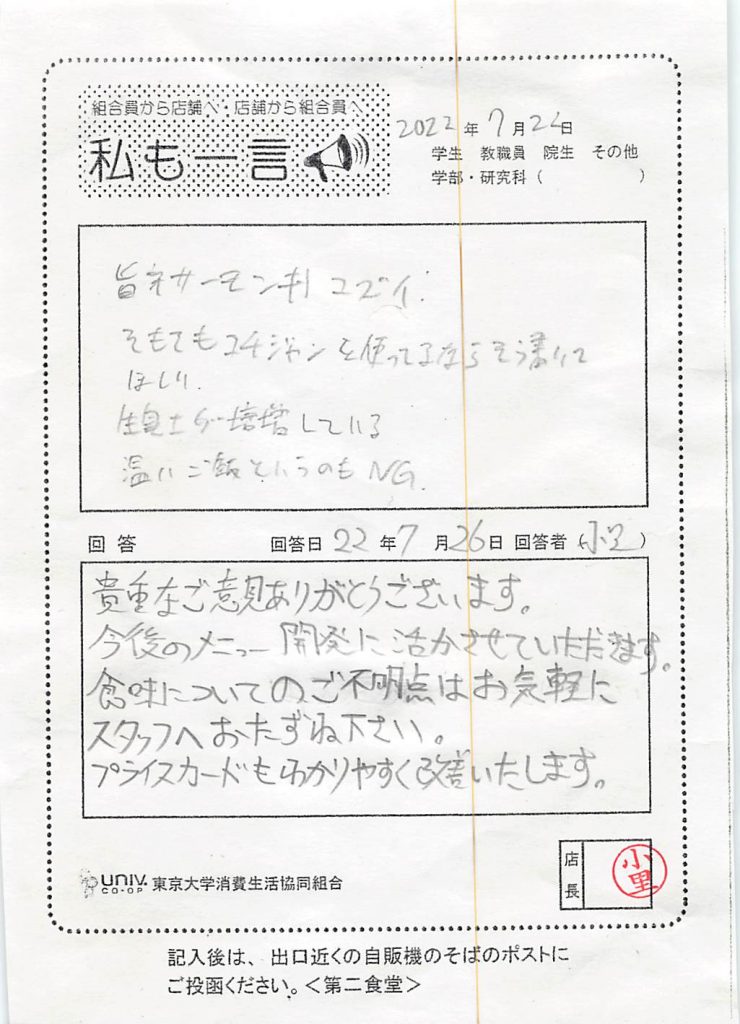
Q:
Regarding the abolition of the Gakushoku Pass service.
It seems that the Gakushoku Pass service will be discontinued, but I feel there has been insufficient explanation as to why. Please explain the rationale for discontinuing it, what advantages the app has over the Gakushoku Pass service, and why the Gakushoku Pass service cannot replace it. Also, while there are likely a small number of subscribers who do not own smartphones, it is unfair to unilaterally discontinue the Gakushoku Pass service and ask them to switch to the app without providing any alternative measures for them. I believe an explanation is needed for this as well. I look forward to your sincere response.
A:
We apologize for any inconvenience caused regarding the transition from cafeteria pass to cafeteria money
The Gakushoku Pass system was linked to a POS register (Toshiba TEC) that was used jointly not only by the University of Tokyo Co-op but also by many other university co-ops in the Tokyo area. As part of a large-scale system overhaul across the nationwide university co-op group, including the Tokyo area, the registers will also be changed, and the Gakushoku Pass system, which was only used in the Tokyo area, will be revamped and made into a smartphone app. Since the services that have been provided through the Gakushoku Pass will continue to be available even after the overhaul, we have decided to ask members to switch to Gakushoku Money. We sincerely apologize for the inconvenience this system switchover will cause our members
As mentioned above, the transition from Gakushoku Pass to Gakushoku Money is part of a nationwide system renewal. However, the existing functions (cashless use at the Co-op cafeteria, use limited to eating, and viewing usage history and nutrition information on the My Page) will remain the same. In the future, we plan to implement point rewards for single items, events, fairs, etc.
Furthermore, alleviating congestion at cafeterias during peak lunch hours at the University of Tokyo Co-op, particularly at Komaba, is a pressing request from members.
We believe that the increasing number of Gakushoku Pass holders and the fact that the Gakushoku Pass is limited to cafeteria menu items are also contributing to this congestion. Since the Co-op sells food items such as bento boxes and beverages not only at cafeterias but also at its stores, we hope to expand the use of the pass to include food items at the stores after the transition to Gakushoku Money, further supporting on-campus dining. By promoting the spread of use of cafeterias and stores, we hope to contribute to reducing congestion.
Finally, we would like to consult with and provide individual support to members who do not have smartphones but are currently using the Gakushoku Pass. From a
system perspective, we believe it is necessary to consider methods of use and payment other than smartphones.
Q:
Tosho Card Next is being sold at a discount at discount shops, so to help reduce the burden of book costs for students, we would like you to consider the following:
1. Negotiate with major discount ticket shops (such as Ticket Ranger, J Market, or Ticketty) to have them install a book card vending machine in the university bookstore and have the shop replenish the book cards as needed. Alternatively, you can take on consignment sales from the discount ticket shop and sell them to students at a discounted price at the bookstore counter
2. The University of Tokyo Co-op will purchase Next Book Cards in bulk from major gift certificate shops at bulk rates and sell them to students at the University Bookstore (and faculty and staff if there are any surplus). In this case, it would probably be necessary to obtain a secondhand goods dealer license under the Secondhand Goods Dealers Act, but since they are planning to obtain a license in order to start trading in computers, I think the hurdle is low
I would also like them to consider other products sold at discount ticket shops that would be useful to students, such as JAL and ANA shareholder discount tickets (for going home, etc.), stamps, and JR Orange Cards (some major discount ticket shops sell stamps at a discount of nearly 20%, while Orange Cards are discounted by nearly 10%). Students can
use discount ticket shops on their own, but because they are small individual customers and therefore cannot qualify for bulk rates, and because shipping costs can be a burden for small transactions, I would like the university co-op to handle these items in bulk.
Q:
You asked if we could sell them at a discount like the book cards sold at gift certificate shops. We apologize for the delay in responding, as we had to check the purchasing conditions of the gift certificate shop based on the information you provided. The bottom line is that
it would be difficult to sell the book cards at a discount even if we purchased them from a gift certificate shop.
The reason is that if we were to purchase the book cards from the gift certificate shop you provided information
about, the purchase price would be higher than the purchase price of a new book card, once the costs involved are taken into account.
co-ops also incur certain costs in running their business,
making it difficult for us to sell the cards at the purchase price.
Q:
I have a question. Following the recent announcement regarding the abolition of the Gakushoku Pass, there is information that the University of Tokyo may follow the trend of other university co-ops and abolish the 10% discount on books for members. Regarding this, I would like to ask whether a decision has been made at this point regarding the abolition of the discount, and whether abolition is being considered at the management level
In addition, as we believe there are many students, faculty and staff members who are interested in this matter, we would also like to request that an official announcement be made in either case
A:
Regarding your inquiry regarding whether the 10% discount on books offered to members will be abolished, the University of Tokyo Co-op has no plans to abolish the current discount on books offered to members
Q:
I know an international student who is a heavy cafeteria user and makes the effort to walk all the way from the Komaba Research Campus to the Komaba First Cafeteria just to eat. Since he can't read Japanese, I thought he would be happy if there were message cards that could be written in English. I
also think that creating an English version of the message cards would be very useful in understanding the difficulties non-Japanese speakers who use the cafeteria have and any misunderstandings they may have about how to use the cafeteria.
A:
Even now, some people are still writing letters in English at the Central Cafeteria and elsewhere, but as you have pointed out, we would like to consider some kind of response. While the information is written in store and on forms, Inquiries - University of Tokyo Consumer Co-op (utcoop.or.jp) , so we would appreciate your patience.