Recruitment
Regular employee
Part-time staff/temporary workers
Those entering the University of Tokyo
inquiry
MENU
Business Hours
MAP
For those entering the University of Tokyo
Business Hours・
MAP
For newcomers (Join
UTcoop
)
Various procedures and changes to member informationAbout
the Co-op appVarious
procedures
Graduation
/Leaving
About
Utcoop
Recruit
Regular employee
Part-time staff/temporary workers
Mutual aid and insurance
Mutual Aid/ Insurance
dining room
Cafeteria
Books and Textbooks
Books
Study and research support
Study & Research Supplies
Driver's license, qualification examination,
W school
License/
Qualification School
Travel/study abroad
Travel/Study Abroad
Job hunting
support
Job hunting
Finding housing
through the University of Tokyo Co-op
House-hunting
Home
Collection of short message cards
Collection of short message cards
Submit your message card
here
Komaba Restaurant
2022
8/3
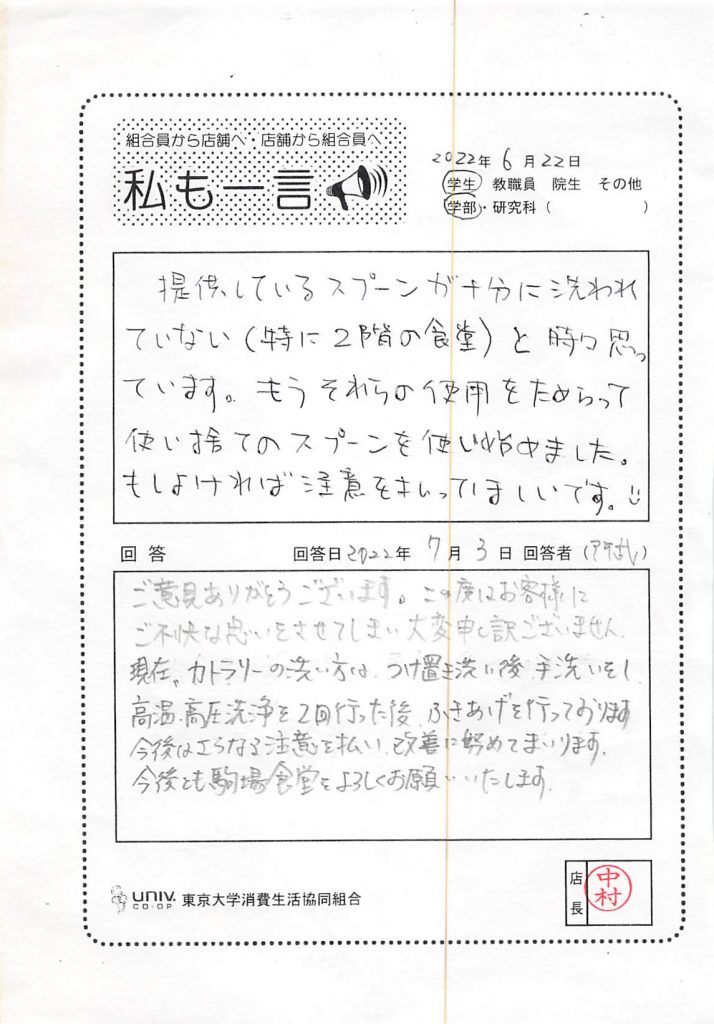
The spoons provided were not washed properly..
Tweet
Komaba Restaurant
2022
8/3
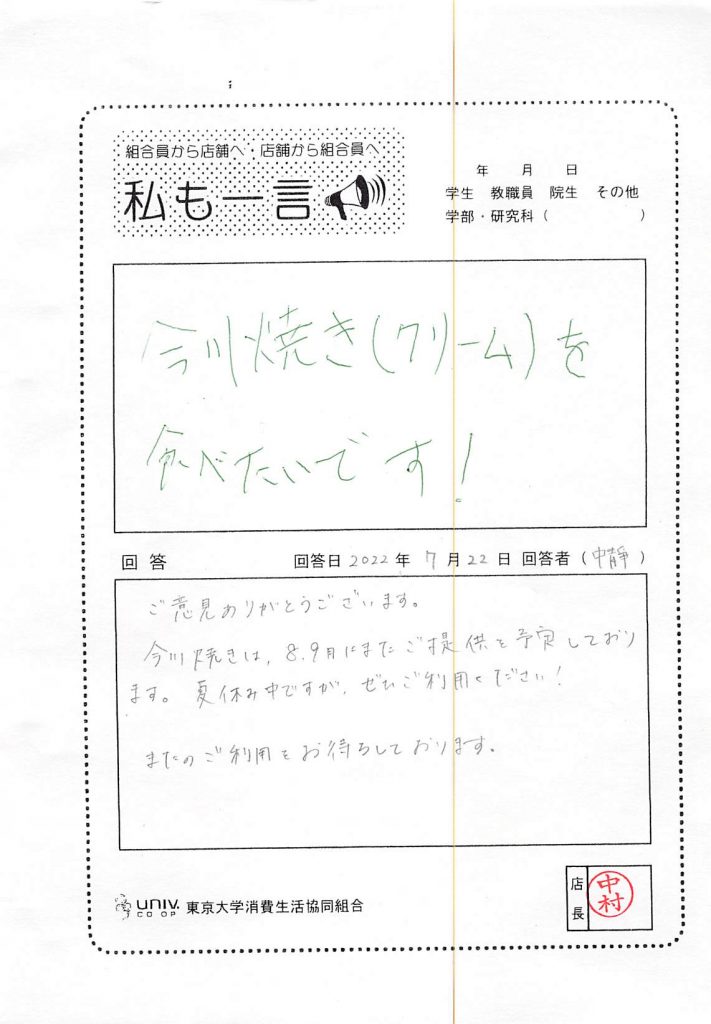
I want to eat Imagawayaki (cream)..
Tweet
Komaba Restaurant
2022
8/3
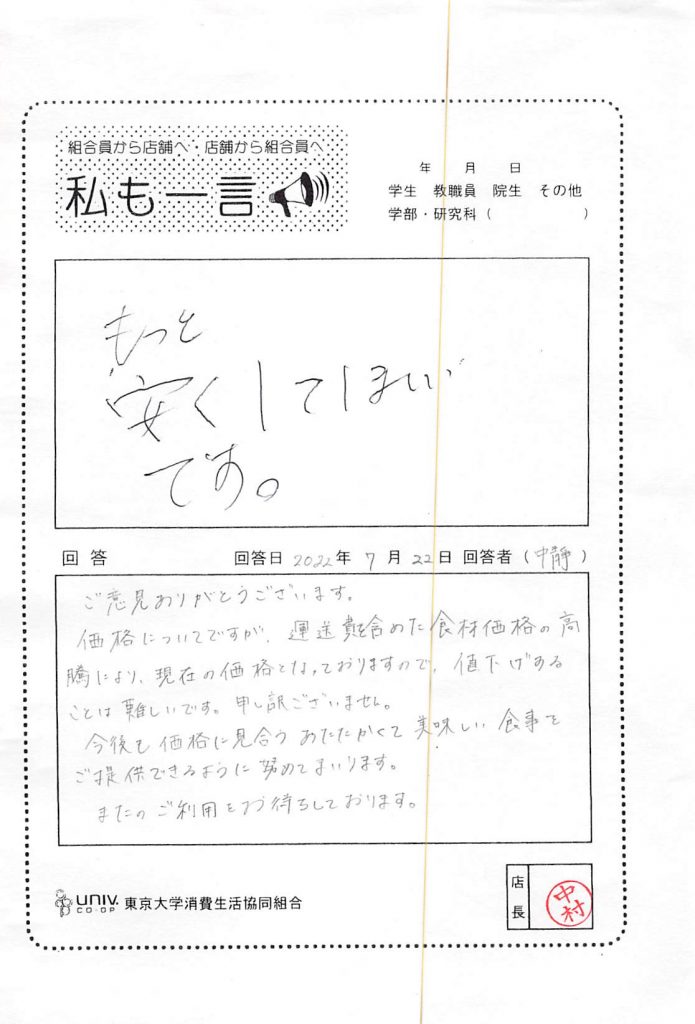
I wish it was cheaper..
Tweet
Komaba Restaurant
2022
8/3
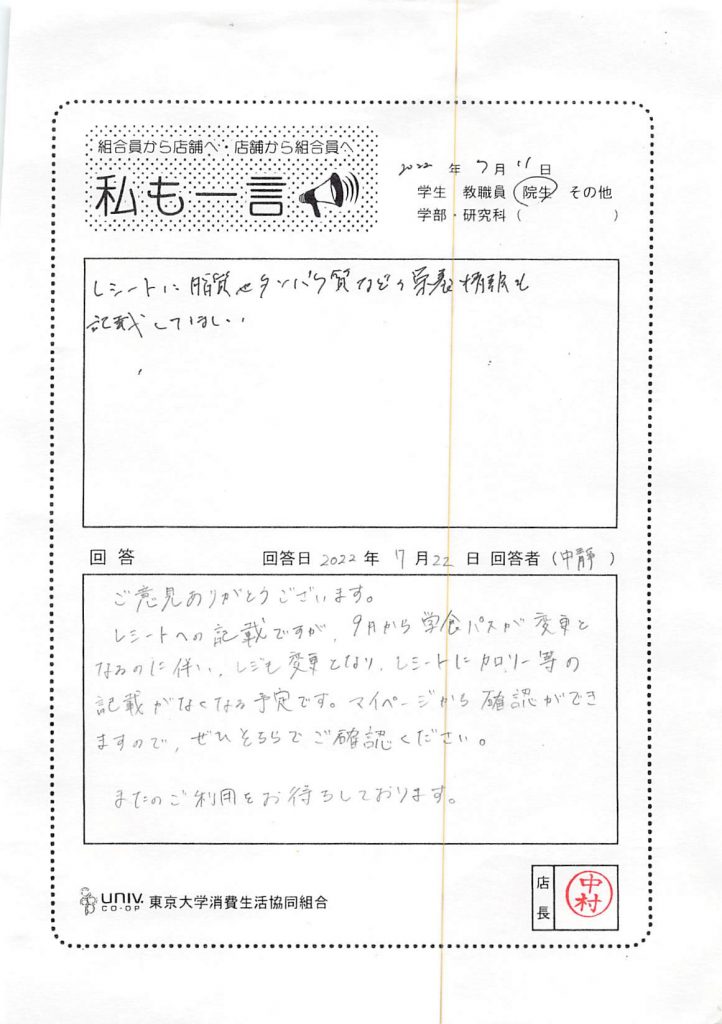
The receipt contains information on fats, proteins, etc
Tweet
Komaba Restaurant
2022
8/3
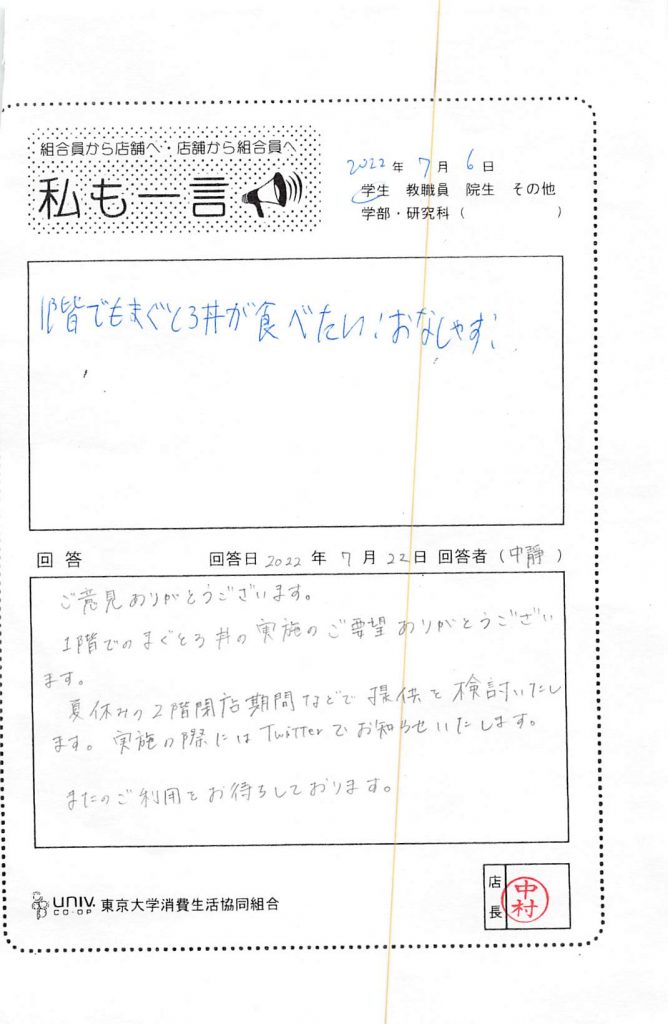
I want to eat tuna rice bowl on the first floor..
Tweet
Komaba Restaurant
2022
8/3
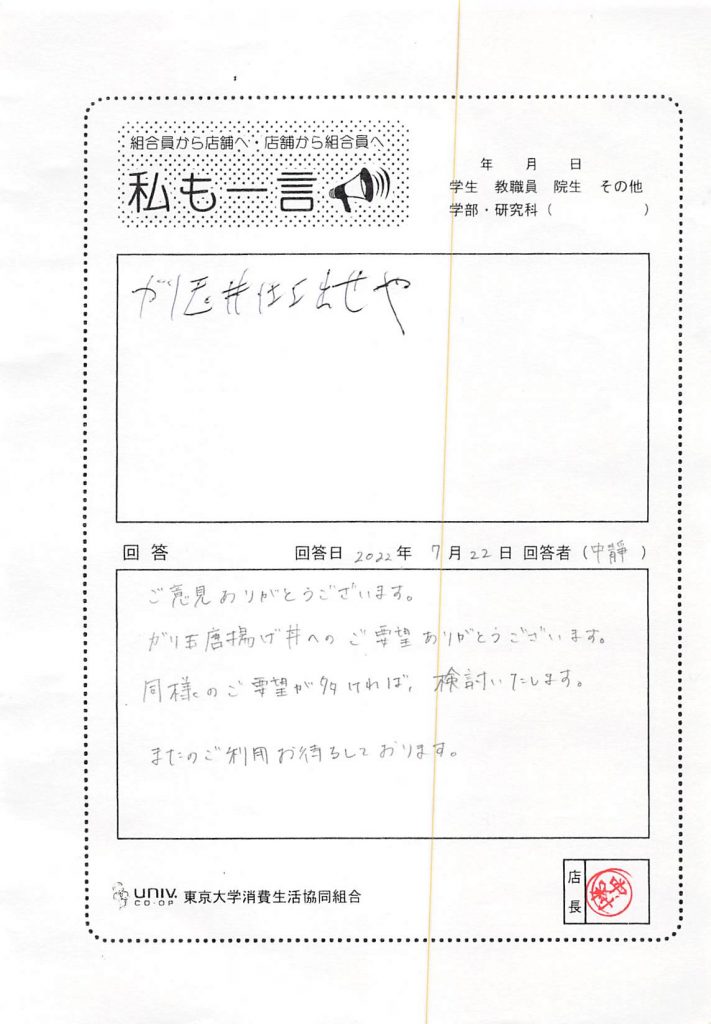
Let's finish off the pickled egg bowl..
Tweet
Komaba Restaurant
2022
8/3
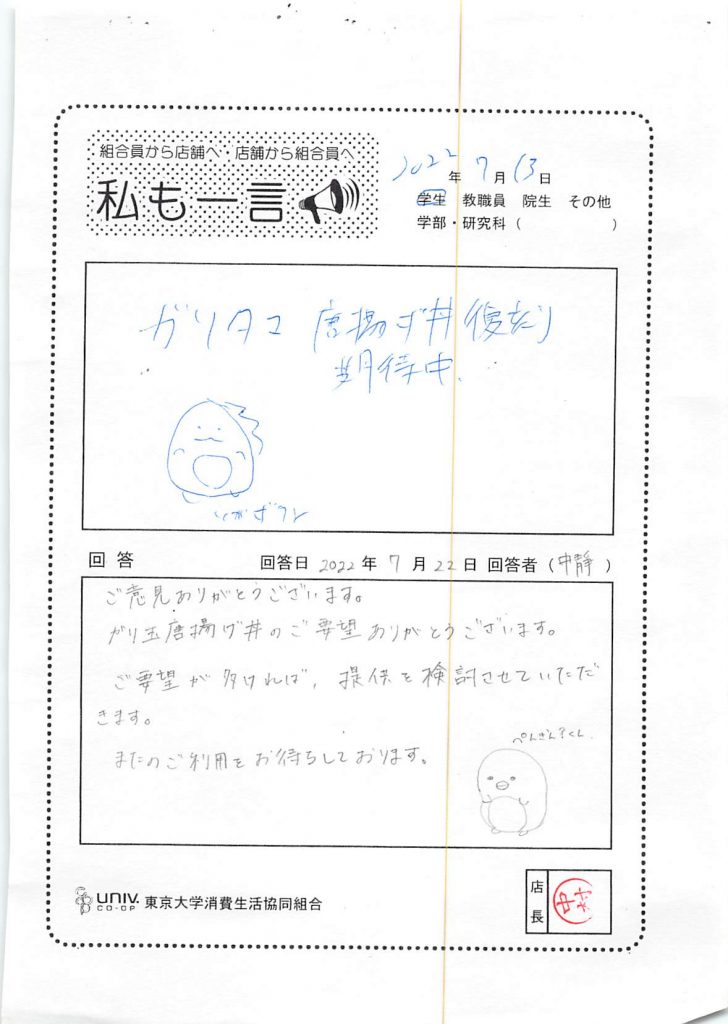
Hoping for the Garitama fried chicken bowl to be re-released..
Tweet
Komaba Restaurant
2022
8/3
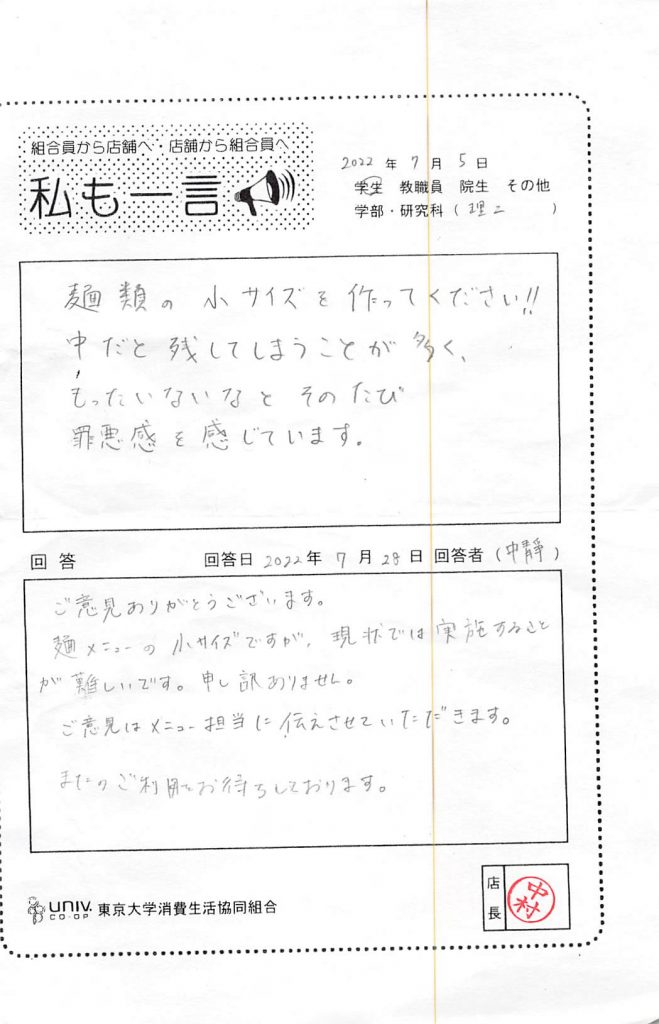
Make small portions of noodles..
Tweet
Komaba Restaurant
2022
8/3
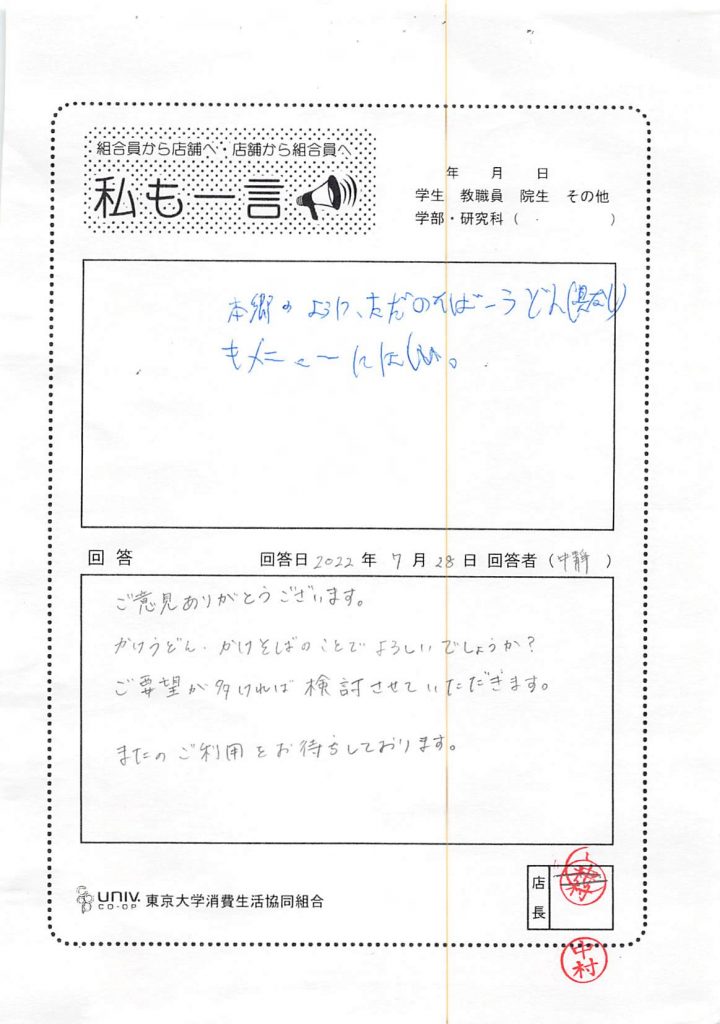
Like Hongo, they also serve plain soba and udon noodles..
Tweet
Komaba Restaurant
2022
8/3
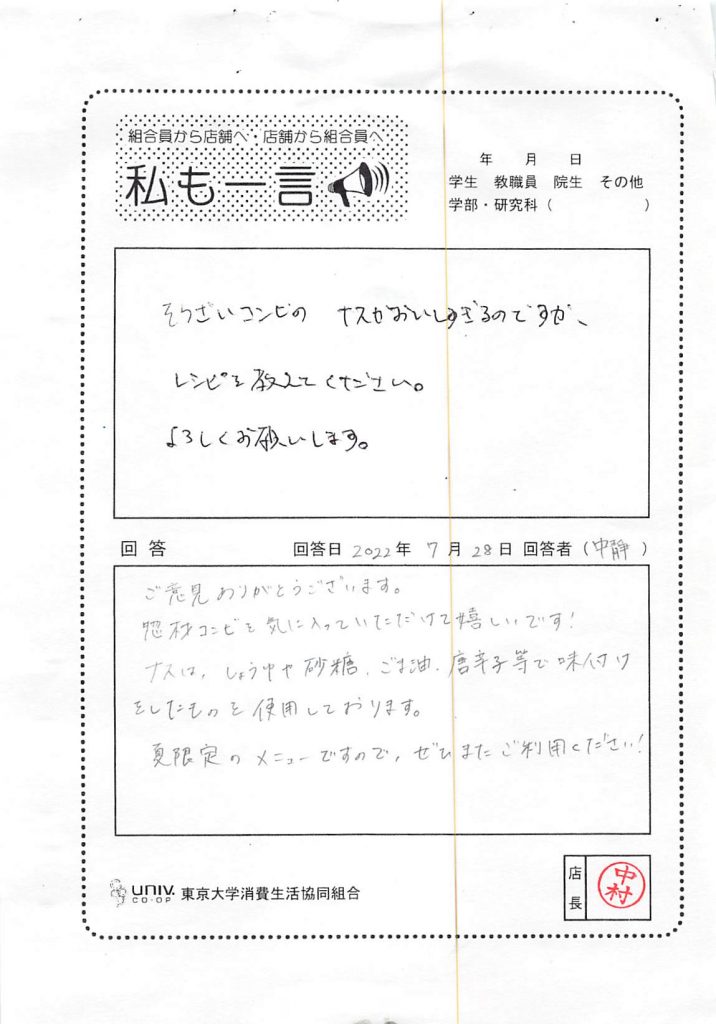
Eggplant is so delicious, can you tell me the recipe?
Tweet
403 / 462
«
‹
402
403
404
›
»
Latest One-line Card
To the bank for the cafeteria payment plan..
Regarding the rice portion size..
Reduced salt content, etc., with health in mind..
It's lunchtime and there are no seats available..
The amount of rice varies depending on who is measuring it..
expensive···
I like sundubu and charcoal-grilled chicken rice bowls..
Please make the non-member price display a little larger..
I'm willing to raise the price..
Please increase the amount of delicious curry available at the University of Tokyo..
Campus-specific message cards
Hongo Second Purchasing Center
Central Cafeteria
Hongo Second Restaurant
Metro Shokudo
Akamon store
Asano store
Komaba West Shop
Komaba Travel Center
Komaba Research
Online submission
Hongo Headquarters
Komaba Office
Komaba Restaurant
Komaba Books
Komaba Purchasing
Hongo Books
Hongo Shokudo
Hongo Purchasing
Yayoi and Asano
oak
medical research institute
Past quote cards
March 2026
(42)
February 2026
(68)
January 2026
(81)
December 2025
(120)
November 2025
(60)
October 2025
(134)
September 2025
(26)
August 2025
(89)
July 2025
(171)
June 2025
(179)
May 2025
(131)
April 2025
(56)
March 2025
(68)
February 2025
(115)
January 2025
(76)
December 2024
(131)
November 2024
(116)
October 2024
(115)
September 2024
(103)
August 2024
(69)
July 2024
(111)
June 2024
(136)
May 2024
(91)
April 2024
(96)
March 2024
(52)
February 2024
(82)
January 2024
(48)
December 2023
(116)
November 2023
(128)
October 2023
(65)
September 2023
(96)
August 2023
(98)
July 2023
(146)
June 2023
(119)
May 2023
(81)
April 2023
(86)
March 2023
(55)
February 2023
(35)
January 2023
(92)
December 2022
(73)
November 2022
(86)
October 2022
(67)
September 2022
(40)
August 2022
(96)
July 2022
(92)
June 2022
(107)
May 2022
(69)
April 2022
(54)
March 2022
(27)
February 2022
(129)
January 2022
(96)
English