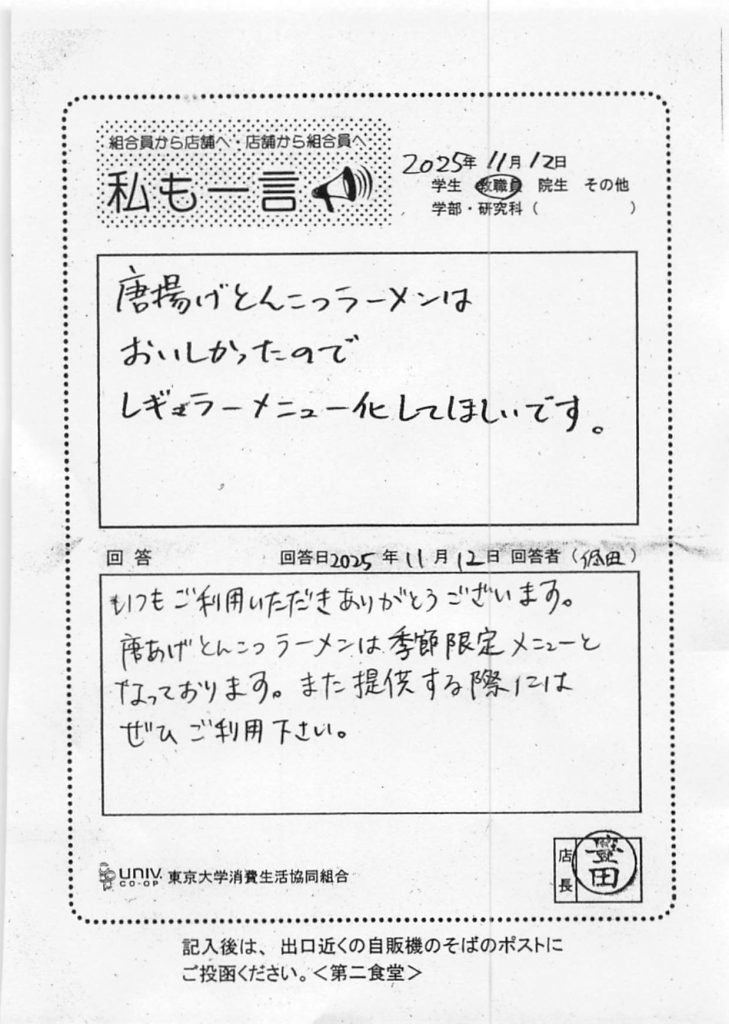
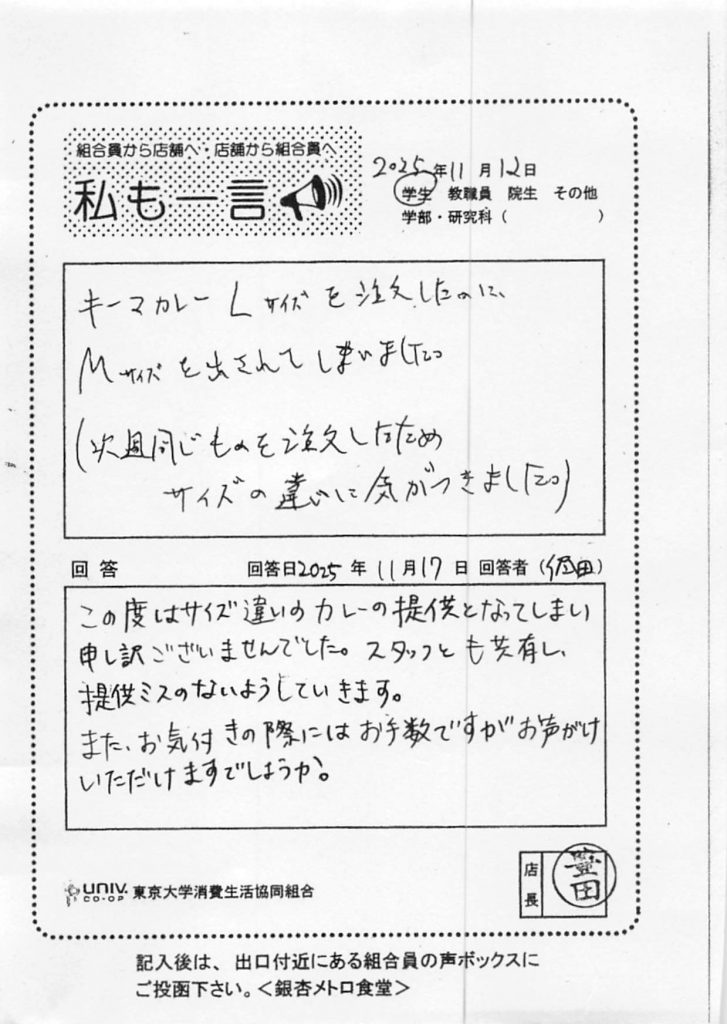
Okonomiyaki-style stir-fry was delicious...

Posting a word cardherefrom


Q:
I'm glad that educational sweets such as Neru Neru Neru are available at the store.
A:
Educational sweets such as Neru-Neru-Neru are not available at the university co-op.
I'm sorry.
If it is proposed as a planned product in the future,
We will consider selling it.
Q:
Just after 1:00 p.m. today, on the first floor of Komaba Dining Hall, an elderly man who appeared to be quite old started accusing some Chinese international students who were eating and chatting, saying, "You're in the way. This is Japan. Speak Japanese."
I don't think these international students were talking loudly or causing any trouble to those around them. Although it's impossible to judge by appearance, I think the elderly people were probably from outside the university, but I never expected to see such blatant xenophobia on campus, and it was a shock to me.
I think it is a good thing that the Co-op's facilities are open to many people, not just those on campus, but that is precisely why I think it is important that the Co-op, as one of the spaces that make up the university (and which is extremely important as it is responsible for food), should make it clear that it is a place that can be used safely regardless of nationality, ethnicity, or gender, and that such hatred will not be tolerated, and that they should also make this clear to users at the cafeteria.
A:
As you mentioned, the University of Tokyo itself is an open university that is used not only by students and faculty but also by local residents and tourists, and the Co-op facilities are used by a variety of people. We would like to convey that it is a place that everyone can use with peace of mind, which is also the Co-op's wish.
Q:
I regularly use the central cafeteria on the University of Tokyo's Hongo campus, but over the past few months, the number of tourists has been overwhelming, making it difficult for students to use. I've heard many complaints from friends around me, and many people I know say they avoid using the cafeteria because it's too crowded and difficult to use. On July 31, 2025, I visited the cafeteria just after it opened at 11:00 AM, but a group of nearly 80 foreign tourists arrived, creating a huge queue. What's worse, they completely ignored the no-photography rule and took unauthorized photos of me. It's true that they may be asking students to refrain from using the cafeteria between 11:30 AM and 1:00 PM. However, very few people are following this rule, and when a large group visits at 11:00 AM, a large number of outside patrons stay, even during the closed hours, leaving almost all the seats occupied, making it difficult for students to use the cafeteria. We're not advocating "Japanese first," but as a university primarily for students, faculty, and staff, we need to strictly enforce rules that prioritize students, faculty, and staff, including not only Japanese students but all international students, including international students, by restricting access to the cafeteria itself. What exactly are they trying to achieve by continually increasing the burden on staff in the central cafeteria, exploiting them with low wages, and continuing to make the students, who are the primary users, feel uncomfortable? If they are so focused on profits through volume sales that they can't even prioritize students and faculty, then they are seriously derelict in their duties, and I believe that the people in charge of sales are slaves to capitalism. I despise them in the strongest terms. Who exactly is this university for? Please stop. I can't take it anymore.
A:
Regarding off-campus use, the Co-op has set time limits for use, posted illustrated and multilingual usage instructions, and has staff members calling out to users, but as you said, the number of off-campus users, including tourists, has been so high over the past few months that it's been difficult for the Co-op. If you see anyone taking photos in the hall, please tell a staff member. The Co-op will continue to respond, but we feel there are limits to what we can do, and we need the cooperation of the university and other related parties on campus. If you have any good solutions, please let us know.
Q:
Even during the restricted hours of 11:30-13:30, the seats are filled with many tourists, and especially since the start of the summer vacation, there have been several occasions when students have had to give up eating at the Central Cafeteria. Even during the summer vacation, many students are studying in the library, and there have been multiple reports from classmates around them that they went to the Central Cafeteria but were unable to eat.
For students, the Central Cafeteria is an essential part of student life, as it is a place where they can have a hot meal at an affordable price in between their busy study schedules. However, looking at the current situation, it seems that it is losing its function as a facility for "campus members (students, faculty and staff)."
We understand that the cafeteria staff are struggling to cope, but we would like to ask you to once again strictly follow the rules.
A:
Regarding non-university users of the cafeteria, we have received various opinions from our members. The Co-op has implemented measures such as restricting use during certain hours, posting illustrated and multilingual user guides, and having staff call out to non-university users. While usage patterns have varied each year since the COVID-19 pandemic, causing confusion, we will consider reopening other cafeterias in August next year. We have also communicated our requests to the university, including issuing warnings to travel agencies and improving guidance when applying for tours. While the guidance has been effective, many users have been able to use the cafeteria outside of the restricted hours. However, there have also been cases where non-university users are unable to distinguish at a glance, or who raise their voices due to language barriers, which has caused distress to Co-op staff. While the Co-op will continue to respond to these requests, we feel there are limits to what we can do, and we need the cooperation of the university and other relevant parties. We welcome any further suggestions for solutions.