


Why is it sometimes the same price as the Lawson right next door?
Q:
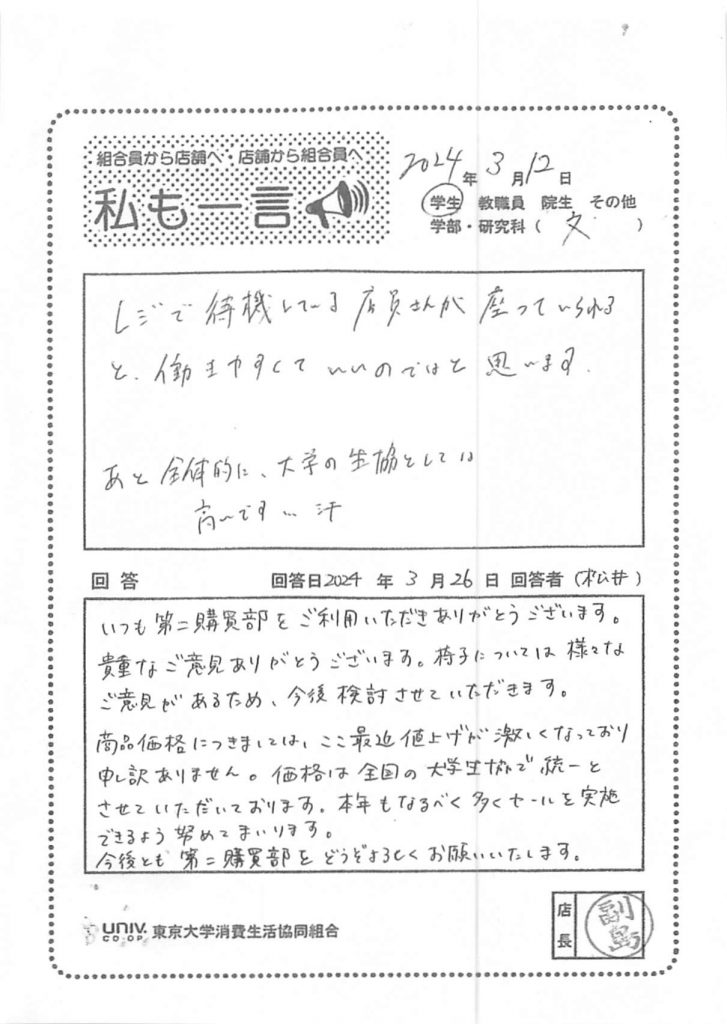
Regarding product pricing, why is it that products such as drinks that can be purchased at convenience stores are sometimes priced the same as those at the Lawson just down the street?
Lawson is a for-profit company, while the Co-op is a non-profit, so they should offer a discount of a few percent, even if it's not the full profit. They should also be able to make a difference by taking into account the labor costs and utility costs that come with not being open 24 hours a day
At present, the only thing I can think of is that the Lawson on the premises is operating at a loss. I feel that this is a case of neglect due to the lack of a large supermarket nearby. I would appreciate your consideration
A:
The University Co-op believes that providing better products at the lowest possible prices is a contribution to its members, and it carries out its business activities accordingly
Regarding the beverages and convenience store products you mentioned (I assume you are referring to bread and rice dishes), our basic pricing philosophy is to ensure that they are not higher than the prices at general convenience stores
As you say, the university co-op is a non-profit organization and is not open 24 hours a day. However, please understand that the scale of business is significantly smaller than that of major convenience stores, and there are various circumstances that make it difficult to improve business efficiency
I believe that Lawson's sales for fiscal year 2022 will be approximately 2.5 trillion yen, with the majority of that coming from the food category. The total supply volume of member co-ops of the University Co-op Business Union, to which the University of Tokyo Co-op entrusts its purchasing and procurement, is roughly 120 billion yen, of which only 12 billion yen is for beverages and food
Major convenience stores have formed dominant areas, optimizing logistics and reducing store management costs, but in the case of university co-ops, they only have stores in areas where universities are located, making it extremely difficult to build efficient logistics.In addition, most of the members are university students, and the population on campus decreases significantly during the summer and spring holidays, which reduces the number of products received and makes it difficult to carry out stable logistics, which is a factor that burdens logistics costs
If profit alone were the priority, it might be most rational to only operate some of the stores in Hongo and Komaba, and not operate stores at other affiliated research institutes with smaller population flows. However, the university co-op, whose mission is to support the welfare of the university, cannot decide on store openings or opening hours based solely on whether they are profitable or not
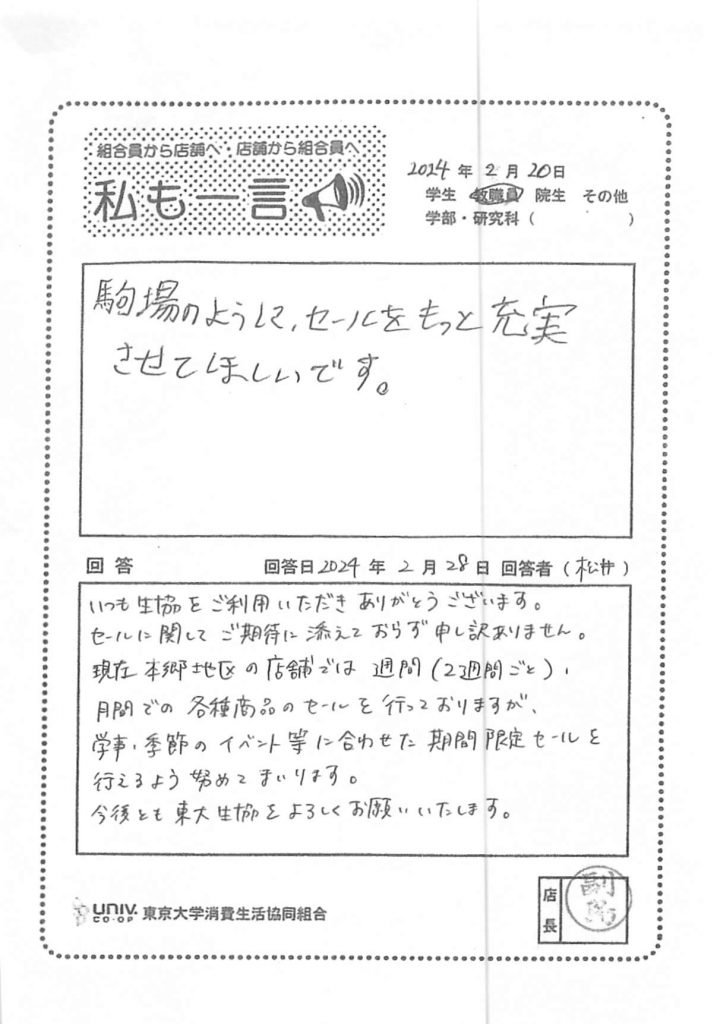
However, this does not mean that "it can't be helped if the co-op is expensive," and we will continue to work hard to make our products as cheap as possible. We would like to continue to take measures such as limited-time sales and price reductions on specific products
Regarding your comment, we would appreciate your understanding that, due to various circumstances, there are some products for which we are unable to offer prices that are different from those of major convenience stores