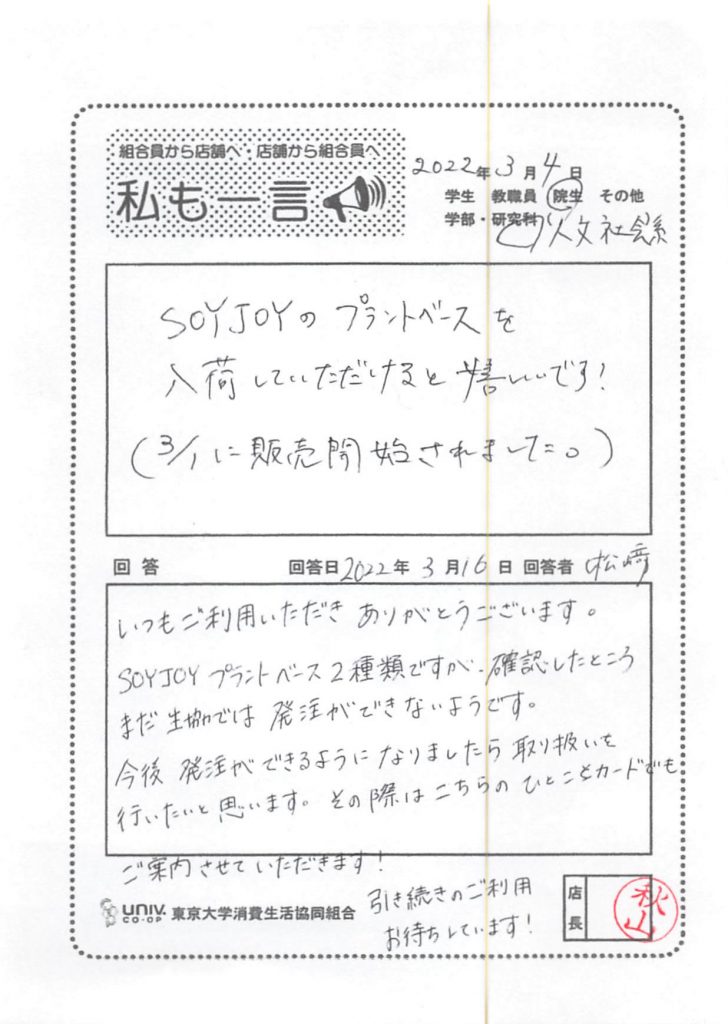
SOYJOY plant-based products have arrived..




Submit your message card here




Q:
It's been a while since plastic bags have been charged for, but it turns out there's no obligation to charge for them if they're made from biodegradable plastic
It seems to me that the current policy on plastics is to "eliminate it" rather than "switch to renewable materials," and that we are losing sight of the true essence of the SDGs
And now plastic spoons and other items will also have to be charged for, so it seems like all of the reforms are not very kind to us users
Although the University of Tokyo Co-op is not an institution directly connected to the University of Tokyo, it is within the University of Tokyo and is rarely seen as the same entity from the outside, so I personally hope that it will take steps towards a sustainable future
That was a long introduction, but I saw something like this the other day
Japan's first marine biodegradable plastic shopping bag completed! Manufacturer Kirax explains the background – Kirax Co., Ltd
Japan's first marine biodegradable plastic shopping bags were completed in April 2021. Kirax, the manufacturer, explains the background to the introduction of marine biodegradable plastics (SDGs and charging for plastic bags), as well as the development process and overview of the bags
www.kiracs.co.jp
According to this page, they have succeeded in developing marine biodegradable plastics (plastics that can be decomposed by microorganisms not only when buried in the soil but also in the ocean) and their processing (especially plastic bags)
It is unclear whether this will solve the microplastic problem, and there is no need to use materials that take the ocean into consideration on the University of Tokyo campus in the first place, but as a co-op located on the University of Tokyo campus, we believe that actively adopting this type of material development with an eye to the future will be a great help in spreading this development
Based on the above, we would like to suggest that you consider using marine biodegradable plastic shopping bags or other plastic products, both for the sake of users and for the sake of environmental activities based on the SDGs, which will likely continue to progress in the future
A:
Thank you for sharing the information and the suggestions
Regarding plastic reduction,
I think retailers, including consumer cooperatives, are being thrown around by policies that give the impression that they are doing something
However, regardless of whether the environmental impact has been reduced or not, the introduction of a charge for plastic bags has led to the following:
I believe there is no doubt that public awareness has been raised regarding this issue
We apologize for any inconvenience caused to our members,
For the time being, we believe that the current rules will continue to be in place, taking into account social norms
Regarding plastic bags, we are working to replace all plastic bags at the University of Tokyo Co-op with biomass materials
Therefore, strictly speaking, they are not subject to a charge and could be distributed free of charge, but as a university co-op whose average customer spending is very low compared to general supermarkets, with some sizes of plastic bags costing more than 5 yen, we believe that reducing the use of plastic bags altogether will reduce our total plastic usage and contribute to the environment
We will continue to consider measures including switching to plastic bags that have a lower environmental impact
We are unable to give specific answers regarding specific measures at this time
We will continue to consider how to balance convenience when using our stores with the environmental impact
This concludes the current explanation
