Recruitment
Regular employee
Part-time staff/temporary workers
Those who will be entering
the University of Tokyo
inquiry
MENU
Business Hours
Map
To those entering
the University of Tokyo
Business
Hours / Map
For newcomers (join
)
UTcoop
Various procedures
/ Changes to member information /
About the Co-op app
Graduation
About
Utcoop
Recruit
Regular employee
Part-time staff/temporary workers
Mutual aid and insurance
Mutual Aid/ Insurance
dining room
Cafeteria
Books and Textbooks
Books
Study and research support
Study & Research Supplies
Driver's License, Qualification Exams, and
Double Schooling
License/
Qualification School
Travel/study abroad
Travel/Study Abroad
Job hunting
support
Job hunting
through the University of Tokyo Co-op
Finding accommodation
House-hunting
Home
Collection of short message cards
Collection of short message cards
Submit your message card
here
.
Central Cafeteria
2026
3/16
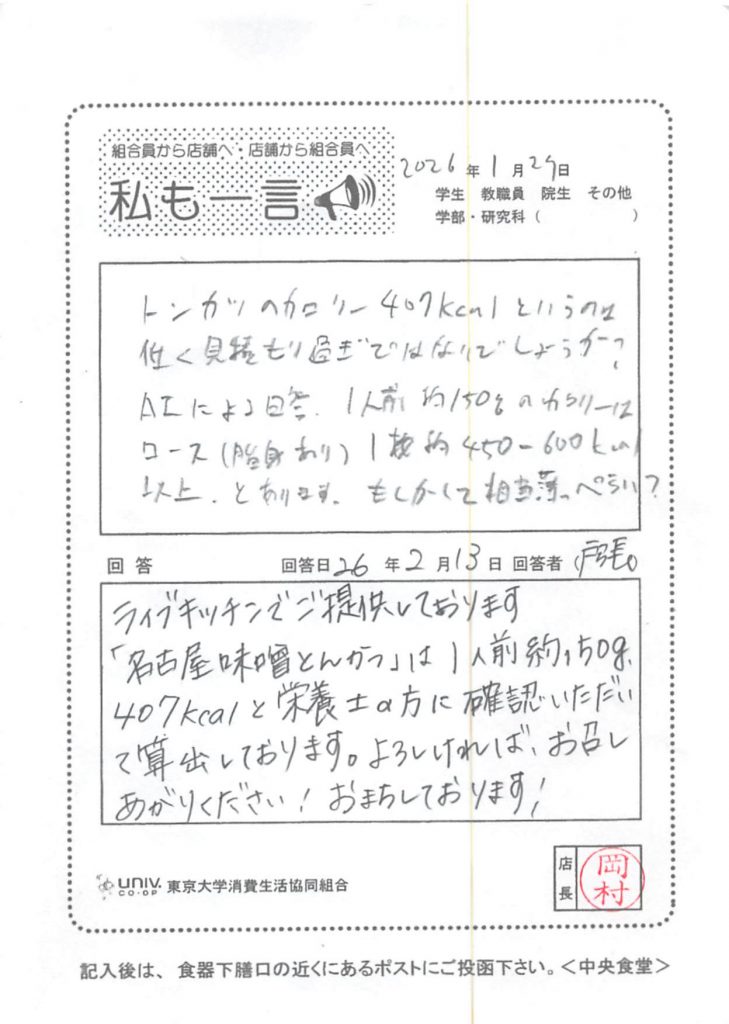
The calorie count of tonkatsu is 407kcal..
Tweet
Central Cafeteria
2026
3/16
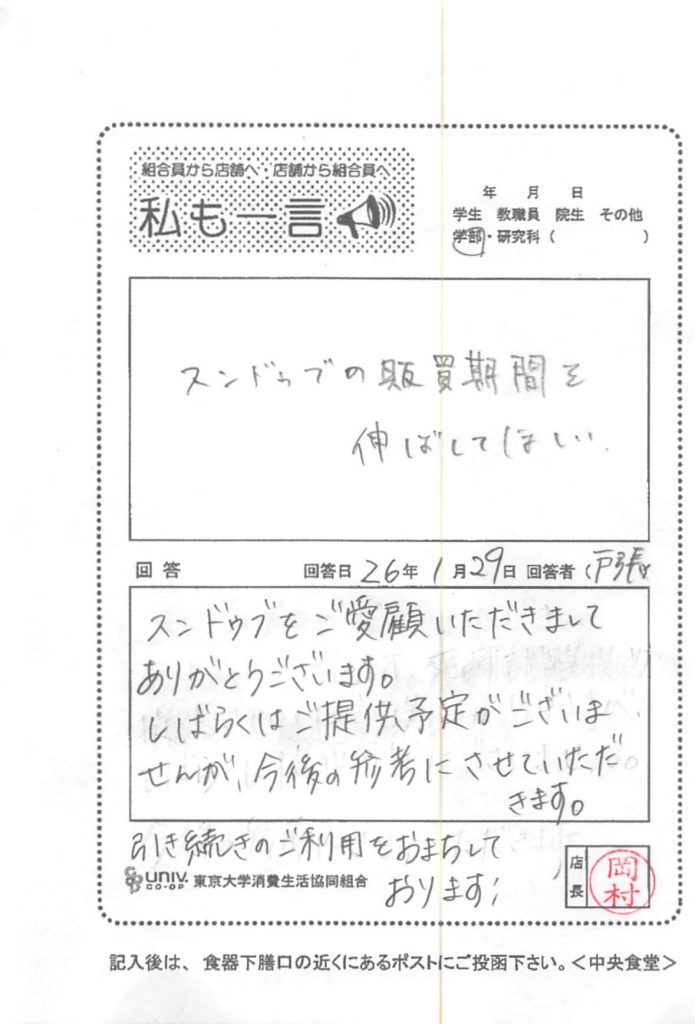
Extend the sales period for sundubu..
Tweet
Komaba Restaurant
2026
3/12
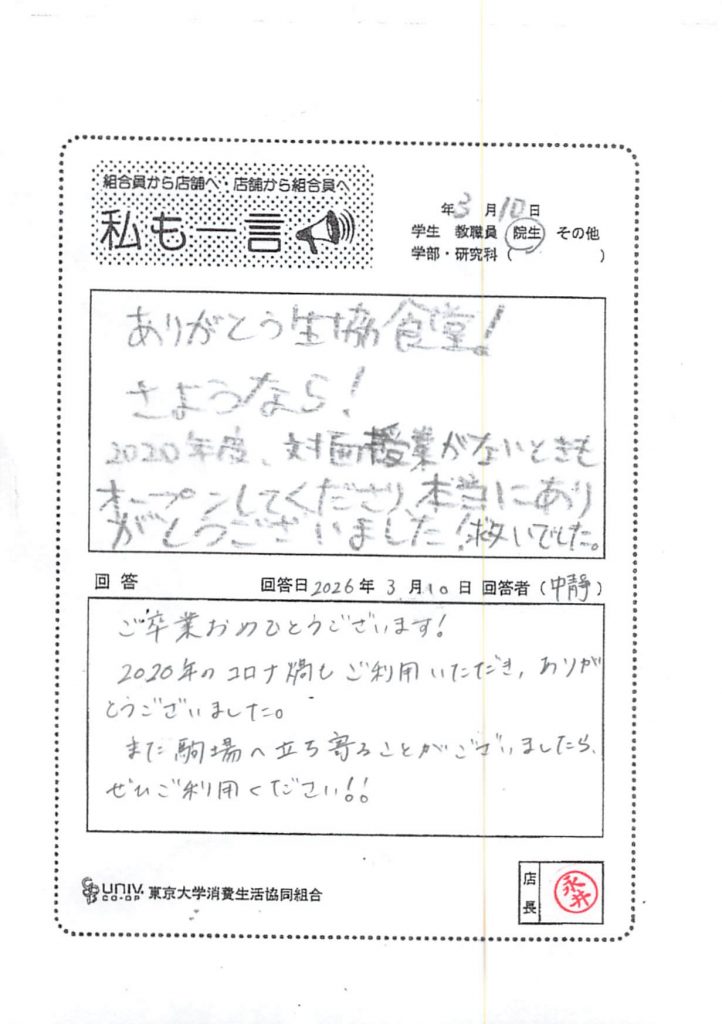
Thank you Co-op Cafeteria!
Tweet
Hongo Second Purchasing Center
2026
3/12
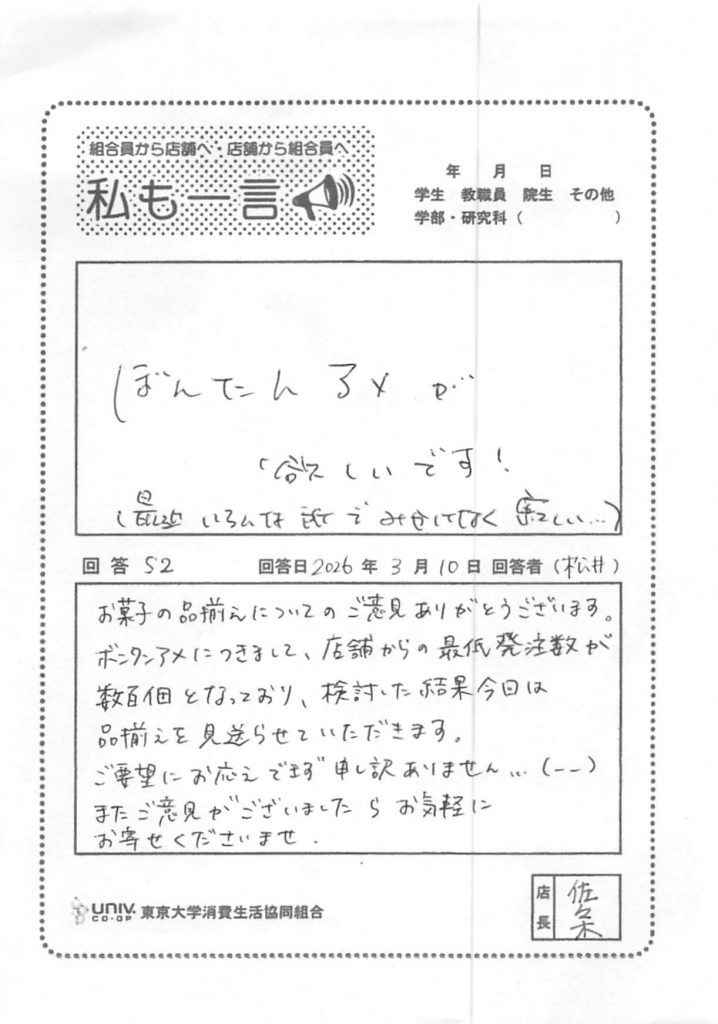
I want some Bontan candy..
Tweet
Hongo Second Purchasing Center
2026
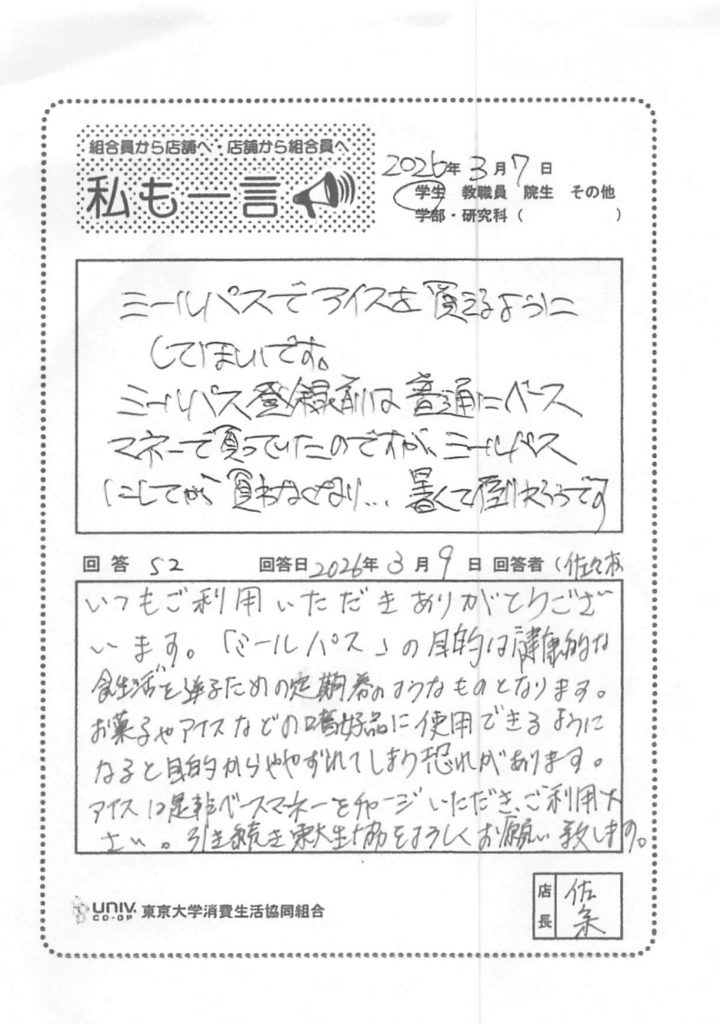
3/12
You can now buy ice cream with Meal Pass..
Tweet
Yayoi and Asano
2026
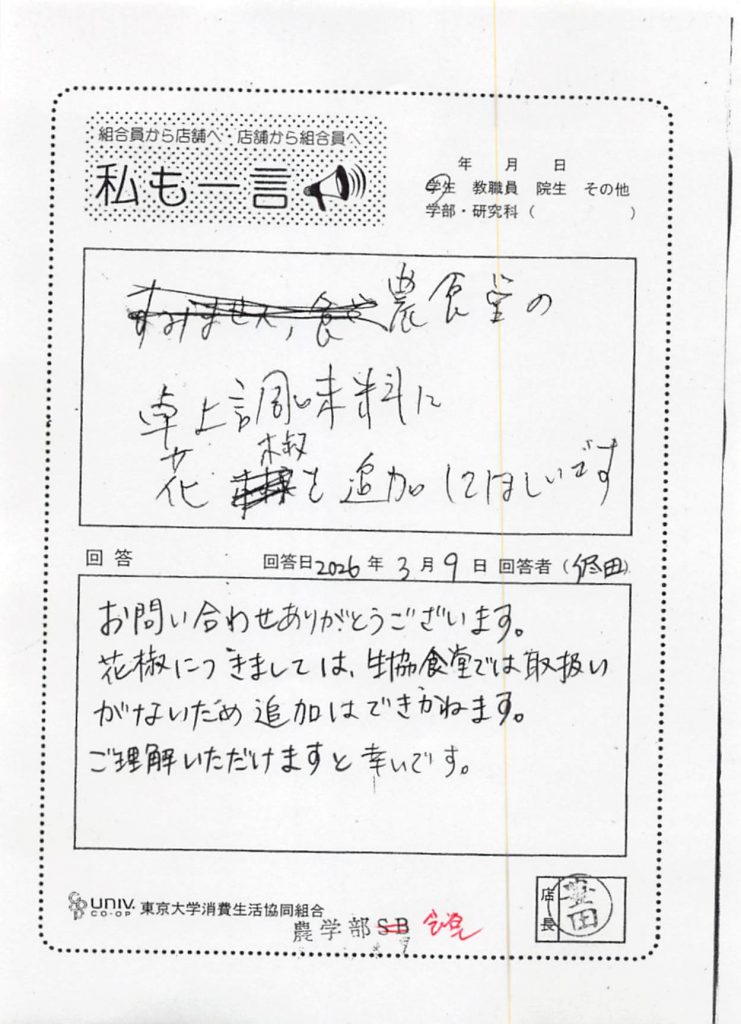
3/12
Add Sichuan peppercorns to your table condiments..
Tweet
Yayoi and Asano
2026
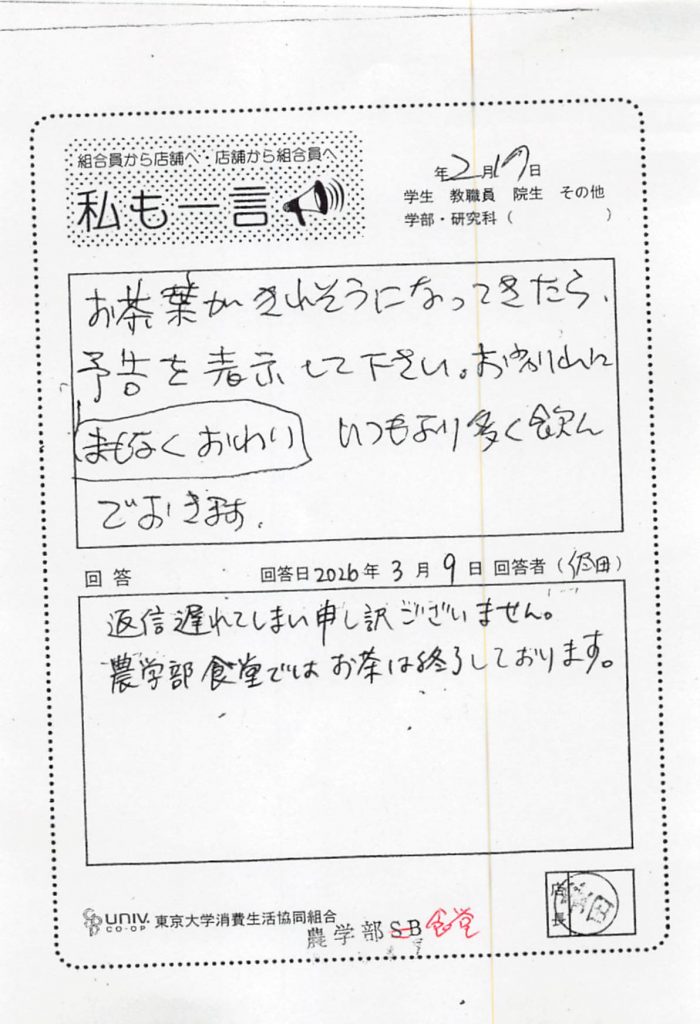
3/12
When the tea leaves are almost gone..
Tweet
Yayoi and Asano
2026
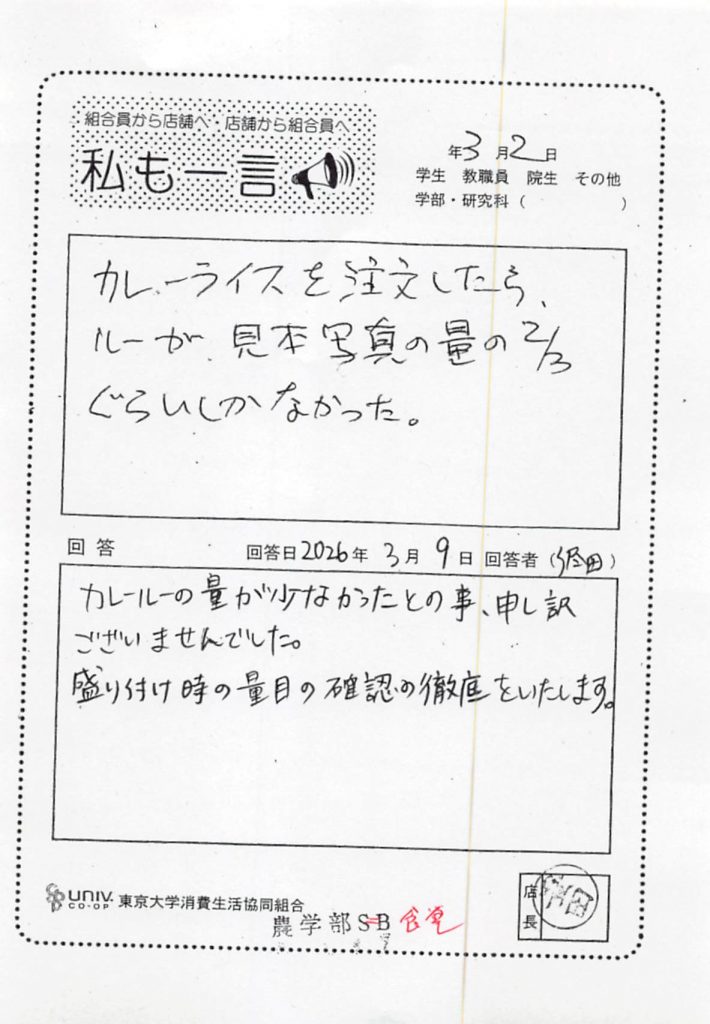
3/12
If you order curry rice..
Tweet
Hongo Second Restaurant
2026
3/12
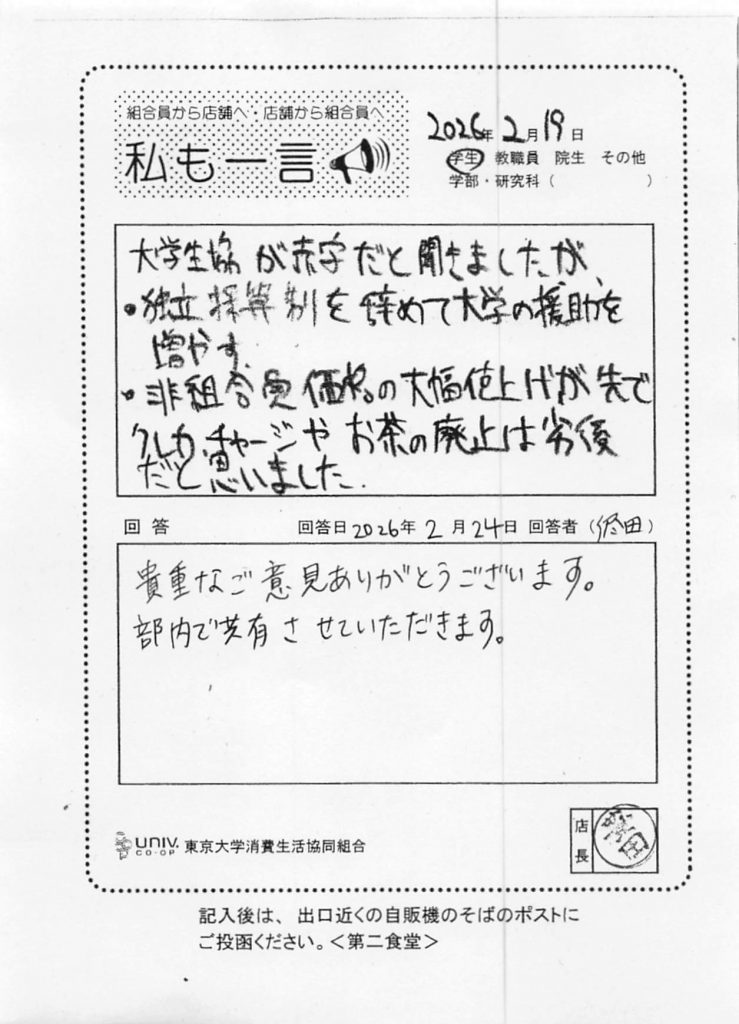
I heard that the university co-op is in the red..
Tweet
Hongo Second Restaurant
2026
3/12
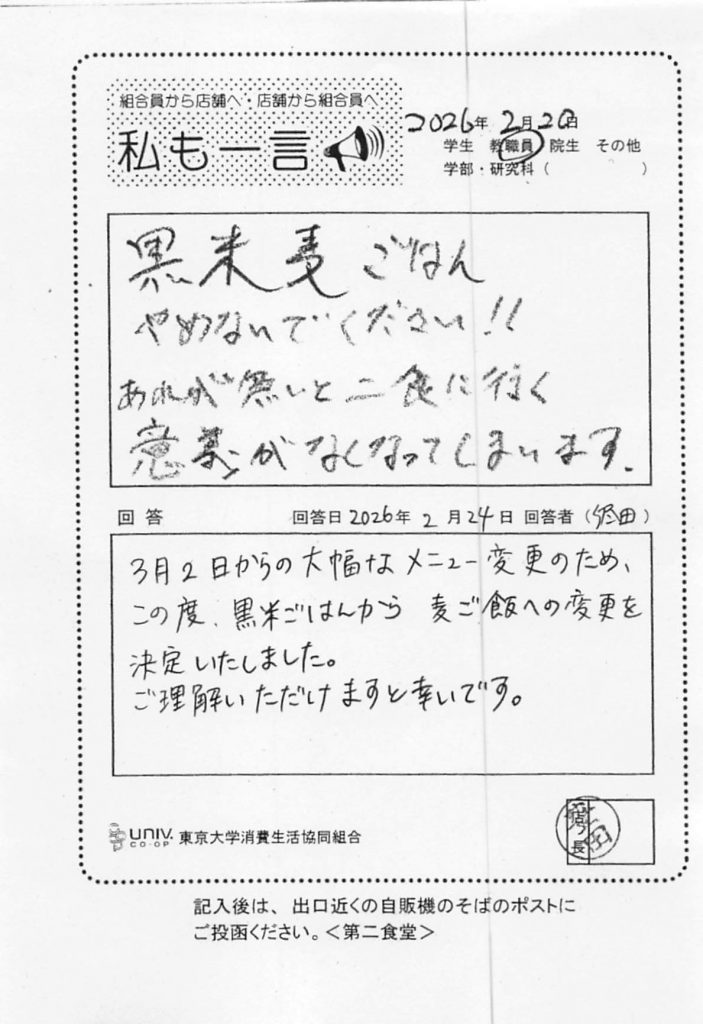
Don't stop eating black rice and barley rice..
Tweet
63 / 522
«
‹
62
63
64
›
»
Latest One-line Card
Is it possible to increase the amount of rice by 1.5 times?
I'm a huge fan of salt-based hamburgers. Could you tell me how to make them?
Bring back the chicken nanban and tea..
Croquettes are underrated..
There was too much sauce on the katsudon..
I'd like to add more tartar sauce to the fried white fish..
Please increase the amount of rice in the negitoro donburi..
They serve stir-fried dishes as a set meal..
We're bringing back the hand-fried chicken nanban set meal..
Fried chicken is delicious..
Campus-specific message cards
Hongo Second Purchasing Center
Central Cafeteria
Hongo Second Restaurant
Metro Shokudo
Akamon store
Asano store
Komaba West Shop
Komaba Travel Center
Komaba Research
Online submission
Hongo Headquarters
Komaba Office
Komaba Restaurant
Komaba Books
Komaba Purchasing
Hongo Books
Hongo Shokudo
Hongo Purchasing
Yayoi and Asano
oak
medical research institute
Past quote cards
October 2026
(50)
September 2026
(65)
August 2026
(40)
July 2026
(154)
June 2026
(117)
May 2026
(77)
April 2026
(95)
March 2026
(42)
February 2026
(68)
January 2026
(81)
December 2025
(120)
November 2025
(60)
October 2025
(134)
September 2025
(26)
August 2025
(89)
July 2025
(171)
June 2025
(179)
May 2025
(131)
April 2025
(56)
March 2025
(68)
February 2025
(115)
January 2025
(76)
December 2024
(131)
November 2024
(116)
October 2024
(115)
September 2024
(103)
August 2024
(69)
July 2024
(111)
June 2024
(136)
May 2024
(91)
April 2024
(96)
March 2024
(52)
February 2024
(82)
January 2024
(48)
December 2023
(116)
November 2023
(128)
October 2023
(65)
September 2023
(96)
August 2023
(98)
July 2023
(146)
June 2023
(119)
May 2023
(81)
April 2023
(86)
March 2023
(55)
February 2023
(35)
January 2023
(92)
December 2022
(73)
November 2022
(86)
October 2022
(67)
September 2022
(40)
August 2022
(96)
July 2022
(92)
June 2022
(107)
May 2022
(69)
April 2022
(54)
March 2022
(27)
February 2022
(129)
January 2022
(96)
English