



- Home
- student committee
- Basic knowledge of graduate student life
- Job hunting advice
Job hunting advice
Many people are unsure of what path to take after completing graduate school. This page introduces employment, one of the career options. We also share the job-hunting experiences of our seniors
Graduate student job hunting
There are, of course, many different ways to find employment as a graduate student. Like undergraduates, some start by attending information sessions and seminars; others work at research institutes or university-affiliated institutions; and others obtain a doctorate and work as a researcher. What sets graduate students apart from undergraduates is that they can utilize the specialized knowledge they acquired in graduate school more than undergraduates. Graduate
school allows students to study a specialized field in greater depth and for longer than undergraduates, so they are expected to apply that knowledge to their work. While the more you advance to graduate school, the more you may be recognized for your diligent study, but the level of expectation also increases. It's important to clearly define your goal and start planning your schedule early so you can balance your research and job search.
Unlike in the past, it's rare to receive a job offer based solely on a faculty recommendation. However, depending on the company you apply to, you may be required to provide a recommendation from your supervisor, especially for research positions. Therefore, it's best to maintain good relationships with faculty members. Make full use of graduate schools, including alumni from your lab, as a gateway to information.
Job hunting season
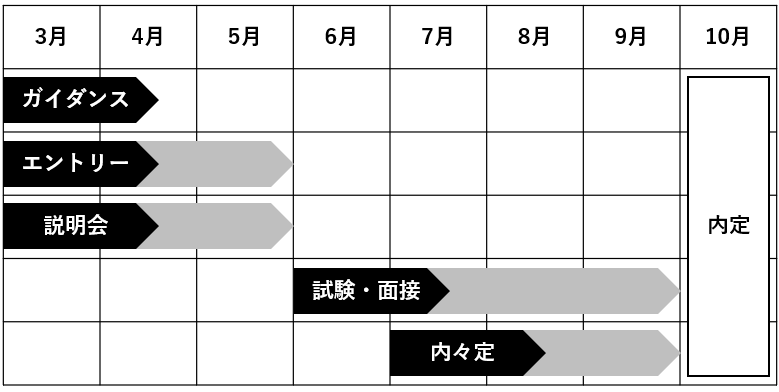
The diagram below shows a rough schedule for job hunting. For those graduating in 2023, the government is recommending that public relations activities begin after March, recruitment selection activities begin after June, and official job offers be made after October. However, because job hunting is expected to be strongly affected by the spread of COVID-19, it will be necessary to make efforts to gather information early on, such as by attending company information sessions, and to proactively find out about recruitment information for your desired industry and companies
Job hunting experiences of seniors
A.K. (Master's graduate in 2017) Graduate School of Interdisciplinary Information Studies, Cultural and Human Informatics Course
It's commonly said that graduate students are at a disadvantage when job hunting, and I personally feel that this is true. In fact, I've seen many of my friends struggle with their job hunts. For liberal arts graduate students, the spring and summer months of their second year of master's degree are often spent conducting serious research and analysis, leaving them with little time for anything else. Naturally, this puts them at a disadvantage.
However, there are also benefits to being a graduate student. When asked the standard job-hunting question, "What did you work hardest on as a student?", you can proudly answer, "My research." Research efforts are surprisingly highly valued in job hunting. Furthermore, the ability to objectively assess your position through daily research and the ability to persuasively assert your passion within that perspective are valuable assets in job applications and interviews.
Looking back, I regret not having started job hunting seriously before the "job hunting ban" began. If I had gained experience with application forms and online tests during my summer internship during my first year of graduate school, when I had more time, and had been lucky enough to receive a verbal job offer during my first year, I might have been able to focus on research during my second year of graduate school.
However, when it came to my job hunt, I went to the company in casual clothes after school and spent the interview talking about how I messed up my seminar presentation that day. Starting in 2017, I will be working in the consulting and research industry. I think I was able to promote myself as a graduate student, including both my strengths and weaknesses, which was what made me stand out during my job hunt.
A.T. (Master's degree, 2021) Graduate School of Engineering, Department of Electrical Engineering
I received a job offer from an electronics manufacturer through a school recommendation. During my job search, I attended joint company information sessions both inside and outside of my university. I decided I wanted to work for a company where I could utilize my academic background, so I applied to companies that offered a department recommendation.
When applying for a technical position, you typically undergo a "technical interview." For each interview, I prepared slides about my research and gave a 10-minute presentation explaining the content and significance of my research and my future research prospects. Afterward, I was asked questions about my research, the efforts I made in my research, and what I focused on outside of my research. These questions were frequently asked by companies, so it's a good idea to plan what to say in advance.
While the format of school recommendations varies depending on your department, in my case, I needed to receive a formal offer. It was difficult to receive this formal offer by March. Furthermore, my job search overlapped with the university's midterm research presentation, which was mentally challenging. However, I finally received the formal offer in May. Even if you use a school recommendation, it is a good idea to not neglect job hunting and to gather information on and apply to a variety of companies.
Y.A. (Master's degree, 2021) Graduate School of Information Science and Technology, Department of Computer Science
In information-related job hunting, it's sometimes possible to leverage internship or part-time work experience, and even people in my major were doing the same. I didn't take that route. Instead, I found a job through both a "scholarly background" and "personal strengths"-based job search, which is probably similar to that of liberal arts students, and a school recommendation job search. (Note: It's important to be aware that some companies won't hire standard applications and will only hire those with a recommendation.) The
biggest difference I felt between standard and recommendation applications was the support provided by the company. With standard applications, unless you specifically request it, there are no opportunities for individual consultations before the selection process, such as alumni visits. Instead, you have to gather information through internships and information sessions. On the other hand, with recommendation applications, while it depends on the major, there are often information sessions held within the department, and there was ample time to visit alumni. I felt like I was given significant preferential treatment, with support provided to help me succeed during the selection process. It's easy to talk about your specialty and use what you've done at university to highlight your accomplishments. While it's likely that the acceptance rate for recommended applications is significantly higher than for regular applications, it's still likely that your application won't go well if you're not careful. While internships and information sessions aren't required, gathering information and taking the selection process as practice, just like for regular applications, are likely to be helpful for recommended applications.
There are also drawbacks to recommended applications, such as restrictions for each major and the general inability to decline, so I recommend carefully considering your application. In my case, I started my recommended application in May and completed it by the end of that month, so I don't think there's any need to rush into applying. However, if possible, I recommend taking the opportunity to visit alumni. Seniors in your major will be very helpful, as they will be very helpful emotionally. (I personally found myself frantically requesting an alumni visit in May when I still hadn't received a job offer.) If you're in trouble, it's a good idea to utilize support available to some majors, such as the Career Support Office or the Science and Engineering Collaborative Career Support Office. You'll likely receive good advice when you're in the most difficult situation.
