



- Home
- student committee
- Basic knowledge of graduate student life
- HOW to research
HOW to research
This page introduces "tips for a fulfilling research life" that will be useful to as many people as possible, as well as financial support systems for graduate students such as SPRING GX, the WISE Graduate School Program, and JSPS Research Fellowships
Research Life Checkpoints
Make a research plan
Research begins with deciding on a research topic. It is essential to create a research plan that spans several years and that can be carried out, especially in graduate school. Ideally, this plan should also be positioned within the scope of research after graduation.
To create a research plan, first research previous research. Discovering what is lacking in previous research will lead to identifying specific, novel research topics. For example, in theoretical research, identifying and correcting theoretical inconsistencies in previous research will become a specific research topic, while in experimental research, increasing the yield of a certain substance will become apparent.
Participate in seminars and research groups
In many graduate schools, practical classes that take the form of presentations and discussions are called "seminars." Many graduate students base their course plans around seminars rather than lectures.
In addition to regular seminars, there are also many independent study groups. These study groups have fewer participants than seminars, and bring together researchers with similar specialties. Also, while seminars are limited to about 90 to 100 minutes, study groups can have in-depth discussions that last from two hours to as long as five hours or more. It is extremely beneficial to exchange information and comments on each other's research through such forums. Participate in these study groups to hone your research skills.
Enjoy your research life
Although it's often overlooked, it's also important to maintain an attitude of "enjoying research life." If you come to university solely for research, you'll be mentally overwhelmed, which could ultimately have a negative impact on your research. Another major feature of graduate school is that you often learn from senior students in addition to faculty. Senior students also have the experience of growing from their own experiences, so they will be happy to offer advice. In particular, when you write a paper or an application for the JSPS Research Fellowship, be sure to show it to your senior and ask for their comments. If you become personally friendly with your senior students, you'll be able to hear about their passion for research and their long-term research goals, which you won't be able to learn from just their research presentations
Join a Society
Academic conferences have three main functions. First, they are a place to present your research. Second, they are a place to gather information. Third, they are a place for researchers to interact with each other. Therefore, while there are obviously benefits to presenting, attending a conference can be very rewarding even if you don't present. Check the information on each conference's website, posters, and word of mouth within the lab.
There are large-scale international conferences that bring together researchers from all over the world, and there are also more intimate conferences with only a few dozen participants each time. In general, the great appeal of large conferences is that they attract many leading researchers. On the other hand, smaller conferences have the advantage of making it easier for researchers to deepen their friendships.
Literature search recommendations
Literature searching is one of the most important skills for research, regardless of whether you are in the sciences or humanities. You can find books necessary for your research or studies using the University of Tokyo OPAC EZproxy . While we've introduced the major literature search sites below, there are specialized search sites for each field, so first ask your faculty or senior colleagues about the search methods commonly used in your field. Citation counts and impact factors are useful indicators for identifying important papers in your field. Mastering literature searching and reading many papers will be the gateway to research.
Introduction to major literature search sites
Often used when searching for Japanese papers
A University of Tokyo website for cross-sectional searches of academic information such as literature
A Google service specializing in academic papers
It is often used mainly in science and engineering
Please note that access to Web of Science and other sites requires authentication from the University of Tokyo. If you use your UTokyo Account via EZproxy
Library Introduction
The University of Tokyo Library website not only allows you to search the University of Tokyo's collection, but also introduces many literature search sites. A convenient inter-campus ordering service (requires logging in to MyOPAC) is also available
Scholarships and research grants
Like undergraduate students, there are a variety of scholarship and research grant programs available to graduate students. However, there are some differences from undergraduate students. For example, when applying, you may be required to submit a research plan and a letter of recommendation from your supervisor. On the other hand, depending on your research results, you may be able to receive more support than undergraduate students, or you may be exempt from the obligation to repay.
Here we will introduce some of the most common grant programs. In addition, your affiliated laboratory may individually provide assistance with finding teaching assistants and research assistants, as well as travel expenses and book costs. It is a good idea to actively ask senior members of your laboratory for more information.
Private Foundation Scholarships
The amount of grant, application procedures, whether or not there is an internal selection process at the university, etc. vary depending on the foundation. Please check with your department for details
Examples of scholarships from private foundations
100,000 yen per month (paid every six months, no repayment required), one year, deadline May 11th (2021 fiscal year)
Toyota-Dwango Advanced Artificial Intelligence Scholarship
Japan Student Services Organization Scholarship Program
There is an obligation to repay the scholarship. There are two types: Type 1 (interest-free) and Type 2 (interest-bearing). The former provides a monthly payment of 50,000 yen or 88,000 yen during the master's program, while the latter allows you to choose a monthly payment between 50,000 yen and 150,000 yen. Only Type 1 recipients are exempt from repaying all or part of the scholarship if they are recognized as having achieved particularly outstanding results (through an examination within their graduate school)
Japan Student Services Organization, Independent Administrative Agency
SPRING GX
The SPRING GX program, which develops highly skilled talent to lead the Green Transformation (GX), is a project being carried out at the University of Tokyo as part of the SPRING Program for Next-Generation Researchers, promoted by the Japan Science and Technology Agency (JST). The program began in October 2021 and is open to doctoral students from all graduate schools, with approximately 600 students being accepted overall. Selected students will receive the SPRING GX core program as well as the advanced skills development program from the World Excellence Graduate School Program (WINGS) they selected during their application. They will also receive financial support, such as research grants and research expenses, until they complete their doctoral program or exceed the standard period of study
Financial support available to SPRING GX recipients
- Research Grants
- 180,000 yen/month. Can be used freely for living expenses, etc. Under tax law, it is treated as miscellaneous income
- research expenses
- A flat-rate of 340,000 yen per year will be provided, and additional funds will be provided after review for overseas travel expenses, etc. This can be used to purchase items and books necessary for research, travel expenses for business trips, and honorariums for collaborators
Senior's experiences
We will share the experiences of seniors who applied for and were accepted into SPRING GX
Mr. D (1st year doctoral student, Graduate School of Information Science and Technology) Hired in October 2021
I chose WINGS: International Graduate Program for Intelligent Society.
I
While the term "GX" might suggest that research must be directly related to energy or global environmental issues, this is not the case. The SPRING GX application guidelines state, "In this project, we consider Green Transformation (GX) to be a social transformation aimed at better managing the global environment, a shared asset of humanity, and handing it over to future generations." The scope of GX in SPRING GX is quite broad. My research field is more fundamental than applied, even within my major. However, I believed that it was deeply related to the broad definition of GX described in the application guidelines, and I submitted my application, which was accepted. In preparing my SPRING GX application, I based my research plan on the research plan I wrote in my DC2 application, while also being conscious of positioning my research within the broad definition of GX. Furthermore, after applying for DC2, my first paper as the lead author was accepted at a peer-reviewed international conference, and being able to include that in my SPRING GX application may have contributed to my success
When applying, please note that some types and amounts of other financial support you are receiving as of the reference date may make you ineligible to apply, and that after selection, there may be certain restrictions on overlap with other financial support from the university. Please read the application guidelines carefully, and if you have any questions, please contact the SPRING GX Business Management Office. Please be especially careful if you are currently working as a research assistant, teaching assistant, or part-timer on campus, or if you plan to work in such a position, and if you have any questions at all, it is a good idea to check with your laboratory secretary or the administrative office of the relevant department
Developing highly skilled human resources to lead the Green Transformation (GX)
Graduate School of Excellence Program
The WISE Graduate School Program is a program promoted by the Ministry of Education, Culture, Sports, Science and Technology (MEXT) and the Japan Society for the Promotion of Science (JSPS). Its goal is to "cultivate doctoral talent (high-level "knowledge professionals") who can lead the creation and utilization of new knowledge, create value that will drive the next generation, and bring innovation to society by tackling social issues." It accepts applications for integrated master's and doctoral programs from various universities.
Some programs address issues that span multiple fields of expertise, while others require advanced expertise beyond the level of a typical graduate school. After passing a selection test and document screening, students are accepted into the program and begin taking classes in the WISE Graduate School Program. Many programs offer stipends and grants that cover all or part of related research and training expenses. This
is a valuable funding source for master's students who are not eligible for JSPS. Furthermore, many programs bring together students and faculty from diverse specialties, providing an ideal environment for reflecting on the significance of one's research and reexamining problems from different angles. Although it can be a big burden to pass qualification exams to advance to the next grade or to continue your studies, if you find one that suits your research topic, you should actively apply. Some programs hold information sessions and start accepting applications in the first year of the master's program, so it's a good idea to start gathering information early.
Example of the University of Tokyo's Graduate School of Excellence Program
The University of Tokyo offers multiple programs. Most programs limit application eligibility based on the department (graduate school) to which you belong. First, find programs in your department that you can apply for
The program is primarily aimed at the Graduate Schools of Law and Politics, and aims to "strengthen graduate education in the rapidly changing field of business law in a broad sense, in both theoretical research and the acquisition of practical knowledge, through close collaboration with practitioners."
International Graduate Program in Advanced Business Law
This program is aimed at students from the Graduate School of Science, Department of Physics, Department of Astronomy, Department of Earth and Planetary Sciences, Department of Chemistry, Graduate School of Engineering, Department of Applied Physics, and Graduate School of Mathematical Sciences, Department of Mathematical Sciences. By utilizing cutting-edge physics and mathematics and through fundamental knowledge of physics and mathematics, students will acquire the skills and knowledge to break new ground and make breakthroughs that will change the world
Cutting-edge Physics and Mathematics Program to Drive Innovation
The program is open to students from certain majors within the Graduate Schools of Medicine, Engineering, Pharmaceutical Sciences, and Science. It aims to cultivate "talent who can contribute to human health from a long-term perspective."
International Graduate School of Life Science and Technology
JSPS Research Fellowship Program
Finally, we'll introduce the JSPS, which many graduate students apply for every year. While the application process for JSPS begins as early as the second year of a master's program, even those newly enrolled in a master's program should be aware of this information as background information.
The JSPS Research Fellowship Program (commonly known as "JSPS") is a program run by the Japan Society for the Promotion of Science (JSPS) to support outstanding young researchers. JSPS offers two types of fellowships: "PD" for those who have completed a doctoral program and "DC" for doctoral students. DC is further divided into "DC1" and "DC2." While "DC1" is awarded for three years from the first year of doctoral study, and "DC2" is awarded for two years from the second year of doctoral study onward, the grant content is generally the same.
DC recipients are eligible for the following grants. Neither grant is required to be repaid.
JSPS Research Fellowship Program
Subsidies available to DC recruits
Research grant of
200,000 yen/month. Can be used freely for living expenses, etc.
Research funding
is limited to a maximum of 1.5 million yen per year. This is limited to specialist books, research equipment, conference participation fees, etc., and a report on the use of the funds is required.
When applying for a JSPS, you will need to write a research plan. Some people say that this has helped them reexamine their own research. If you have a senior in your lab who has experience with JSPS, it would be a good idea to ask them for more detailed information, including how to create and present a research plan
How many people are employed?
2019 Student Life Survey : JSPS Selection and Application Status of Doctoral Students
| JSPS | 25.1% |
|---|---|
| I applied but wasn't accepted | 32.2% |
| Not eligible to apply | 12.7% |
| No need to receive JSPS | 10.7% |
| others | 19.3% |
From the data above, we can see that 43.8% of graduate students at the University of Tokyo who applied to the JSPS were accepted. The DC acceptance rate published on the JSPS website
JSPS application process
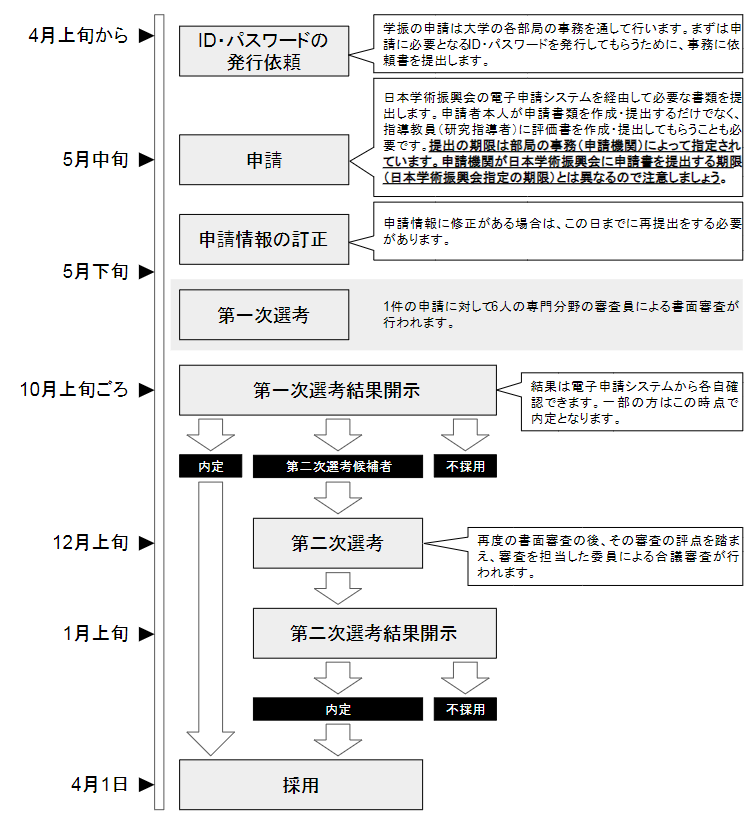
This section introduces the application process for DC1 and DC2 for FY2022 in chronological order. Please note that the administrative schedule may vary depending on your department. For more information, please contact the administrative office of your department
Senior's experiences
We will share the experiences of seniors who applied for the JSPS and received job offers
Mr. K (2nd year doctoral student, Graduate School of Agricultural and Life Sciences), DC2 (Agriculture/Environmental Studies), hired in 2020
I had no intention of continuing my studies at the time of the DC1 application, so I did not apply. I applied for DC2 for the first time in my first year of doctoral studies, but was rejected. I was accepted on my second attempt. I would like to share my experience, including my previous rejection
Research Achievements
The main information to be filled in on the DC application form is "Research Results," "Research Plan," "Research Achievements," and "Qualities as a Researcher." (Note: The application form format has changed significantly from the 2022 recruitment period, and now consists of three sections: "Research Plan," "Self-Analysis of Research Execution Ability," and "Ideal Researcher.") While each section is important, it is said that achievements, especially the number of papers, have a major impact on whether you are accepted or not. In my case, last time I applied, I did not have a single paper published as lead author. Thankfully, with the support of my supervisor, I was able to submit a paper as lead author based on my master's thesis. I also believe that my steady achievements, such as presenting at academic conferences and winning awards, led to my acceptance
Easy-to-understand application documents
The DC grant selection process is conducted by six judges from the "Special Research Fellows Review Committee, composed of Japan's leading researchers" (according to the Japan Society for the Promotion of Science website). The key is to write an application that conveys what you want to convey to the judges in a short amount of time. In my case, my previous application was only reviewed by my supervisor. Given the limited time available, my application was somewhat rough. This time, I asked senior and junior colleagues in my lab, as well as friends who are not familiar with my research, to review my application. Getting feedback from many different people helped me identify mistakes I might not have noticed on my own. I also attended a JSPS seminar hosted by a research society, where I looked at the applications of successful applicants and learned techniques for writing a good application. It seems that various groups hold seminars, so it's a good idea to attend one before applying. I
also had a variety of experiences, including taking the University of Tokyo FFP program and spending a week conducting research at an overseas research institute. These experiences not only helped me to highlight my application, but also helped me improve my skills as a researcher.
Research Achievements
Todai FFP stands for the University of Tokyo Future Faculty Program. It is a program aimed at improving the teaching skills of graduate students and young faculty members. Participants can learn how to create university lectures
