



- Home
- student committee
- Basic knowledge of graduate student life
- Differences between undergraduate and graduate schools
Differences between undergraduate and graduate schools
Your new life at graduate school is about to begin. But how is graduate school different from undergraduate school?
This page will explain the administrative aspects of graduate school, such as credits and lectures, while sharing personal experiences.
Graduate school lectures
Required credits
The number of credits required is about 30 for a master's degree and 20 for a doctoral degree (including master's and doctoral theses). The details differ depending on the graduate school and course, so please check the handbook distributed at the orientation. First, it is important to understand the required courses such as seminars and graduation theses. For the remaining credits, you may be allowed to take lectures outside of your course. You may also be allowed to take lectures for undergraduate students
Course plan during enrollment
Graduate students are primarily focused on research. Therefore, even though there is no upper limit on the number of credits they can take, it is not a good idea to cram too many lectures into your studies. However, the later you are in your studies, the busier your research for final theses and other projects tends to become, so it is best to get all your credits as soon as possible. In a master's program, if you take about 6-7 classes per week, you will be able to get most of your credits by the second year, so it should not be too much of a burden. One of the great things about graduate school is that there are no strict restrictions on credits.
Furthermore, those who go on to a doctoral program may be able to carry over any extra credits they earn during their master's program to their doctoral program.
Notes on course registration
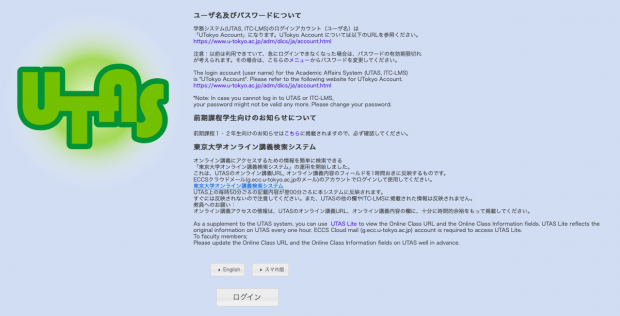
Course registration for lectures is done using the online system called UTAS
Lecture content
There are a variety of graduate school lectures, but compared to undergraduates, the proportion of seminar-style lectures is higher. In other words, a certain literature is read by a group, the instructor gives a presentation, and students deepen their understanding through questions and discussions about the content. Resumes are often of high quality, requiring careful preparation and a considerable amount of prior knowledge. However, if you change your perspective, your research topic can be applied to any presentation, so the more motivated you are to work, the more interesting your seminar will be.
Depending on the lab or major, you may also be required to attend seminars once or twice a week (these are required courses). The content mainly consists of research presentations and paper introductions, and they are often held jointly with other labs, providing an opportunity to broaden your research horizons.
About TA
At the master's level, you may be asked to work as a teaching assistant (TA), helping with lectures and mentoring undergraduate students. Often, the position naturally comes up within the lab, and it's usually a part-time job with an hourly wage of around 1,300 yen. Students appreciate this position because it allows them to attend classes while also working part-time, making it an easy way to earn money on campus. In addition, the time spent on tasks such as preparing materials may also be reflected in your salary. However, the workload may increase at the end of the semester, as you may have to compile reports for undergraduate students and grade tests. Since this position often overlaps with busy periods for job hunting and research, it's a good idea to understand the job content beforehand
Life in the lab
The role of graduate students
In many laboratories, first-year master's students are tasked with running and managing the independent seminars and meetings held within the lab. Graduate students also primarily maintain student rooms and laboratories, and plan events both inside and outside the lab, such as research meetings and training camps. Depending on the lab, graduate students may also be responsible for updating the website, ordering supplies, and managing invoices. Another important role for graduate students is mentoring junior students. In laboratories with a particularly large number of fourth-year undergraduate students, graduate students may be asked to check slides and meeting materials and offer advice on research. While circumstances vary somewhat from student to student, there is no doubt that graduate students are the core of the lab. Laboratories are places with deep ties to society, and graduate students are expected to behave as members of society. Graduate school is also a place to learn about society
About part-time jobs
According to the 2019 Student Life Survey, 65.6% of graduate students at the University of Tokyo have part-time jobs, comparable to the 67.1% of undergraduate students (according to the same survey in 2020). By type, 33.3% are TAs, 17.6% are cram school/preparatory school instructors, and 7.9% are private tutors. Some students work part-time in the food service industry or as office staff, while others focus on research during the week and work part-time jobs on weekends. Research is largely at the discretion of the individual, and it is possible to find time through careful time management. However, time commitments vary greatly depending on the lab. Some labs require students to come to the lab on weekends, and many labs have frequent research commitments, making part-time work difficult. It's a good idea to consult with your seniors and professors before starting
Enjoying life in the lab
While laboratories are places where research and chores are carried out, they are also places where people with various backgrounds gather and talk. There are many laboratories where members get along well both inside and outside of school, and they often meet up for drinks every weekend or play sports together on the days off. At the same time, it is also true that some people struggle with interpersonal relationships in the lab or suffer from academic harassment from faculty. If you have any concerns, please seek help from a harassment counseling center or student counseling center
University of Tokyo Counseling Support Research and Development Center
About international students and English
About international students
Graduate school offers significantly more opportunities to interact with international students than undergraduate school. There are 4,274 international students (as of November 1, 2021) in master's, doctoral, and research programs across the graduate school, with 3,829 coming from Asia. Generally, there are more international students in science laboratories, and in some laboratories there are even more international students than Japanese students. When an international student is enrolled in a laboratory, graduate students act as tutors, helping with government applications and daily life. Interacting with international students also provides an opportunity to learn English, so be sure to actively engage with them
English in research settings
In graduate school, whether in the sciences or humanities, there are many opportunities to use English. This is a field that has hardly been studied in Japan, and many specialized books are only available in English. Some schools hold all meetings in English, so if you cannot speak English, you will have a very hard time.
Some graduate schools also offer special English lessons by inviting external English instructors.
Graduate school life of seniors
C.K. (1st year master's student, Comprehensive Analytical Informatics course, Department of Interdisciplinary Information Studies, Graduate School of Interdisciplinary Information Studies)
About the lecture

To make my research life easier later, I decided to earn all the credits I could during my first year of master's studies, excluding my master's thesis. In fact, professors at the graduate school actually recommend taking all the required credits, such as the introduction course, during the first year. In my lab, students generally take the same courses, so I made sure to schedule general meetings and research seminars during times when those courses were not available. While it may seem easier with fewer lectures than undergraduate studies, it's still busy when you consider research activities (researching papers for research, working, studying, preparing presentations at meetings, etc.), so it's important to plan ahead and balance your lectures and research activities.
If it's difficult to find a set time each week, you can also consider taking intensive courses. The Graduate School of Interdisciplinary Information Studies holds a creative exhibition, bringing together students from various courses. This exhibition, if properly completed, also counts as credits.
C.K.'s timetable
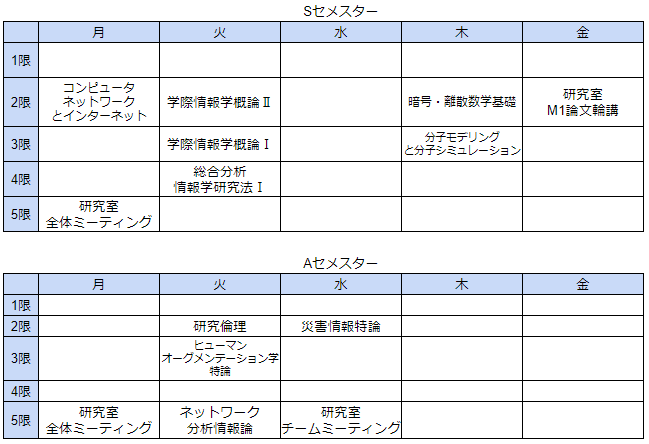
Intensive Lecture: Fundamentals of AI Systems
Intensive Lecture: Practical AI Systems
Intensive Lecture: Special Lecture on Comprehensive Analytical Informatics XIIIA
Year-long intensive course: Introduction to Interdisciplinary Information Studies III
Research Life
My research focuses on programming and field experiments for building smart building systems. Previously, many students would go to the lab daily, but due to the COVID-19 pandemic, almost all research activities, including general and team meetings, can now be conducted from home. However, some students still work in the lab to concentrate.
My field often uses machine learning for research, so the lab is equipped with several high-performance computers. While managing access rights and other details is left to students, there's no need to worry if you check handover documents or ask your professors or senior colleagues for help. In addition, the lab is divided into teams based on research fields, and weekly team meetings allow students to report and discuss the progress of their research with their professors. When you're unsure how to proceed with your research, it's important to avoid worrying alone and to consult with your professors or senior colleagues. You may be able to find a solution you wouldn't have noticed on your own. While balancing research
and job hunting is currently a challenge, I'd like to continue my efforts to find an interesting research topic through trial and error and use it to contribute to my master's thesis.
T.K. (1st year master's student, Graduate School of Education, Department of Educational Sciences)
About the lecture
It's sometimes difficult to predict how long research will take. Therefore, it's wise to complete all the credits you need to graduate as soon as possible.
For those enrolled from outside the university (though I had a different major in undergraduate studies), it's also important to attend undergraduate lectures and learn the basics. Although there are limitations on undergraduate lectures, some can be counted toward graduation credits, so I actively attended them. I also attended seminars in other courses to broaden my knowledge.
The most difficult part was the increased number of chores, such as lab management, seminar management, and dinner party arrangements. I think it's the same in any lab: you can't devote all your time to studying or research. As a graduate student, I realized how important it is to manage your time and schedule.
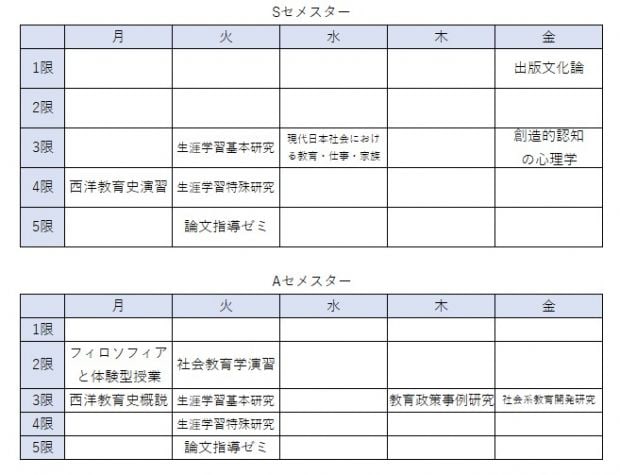
T.K.'s timetable
Research Life
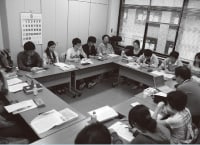
The amount of time spent on research varies depending on the research topic. If research involves digging into materials, many researchers spend their time outside of lectures and seminars in the library.
Those who conduct full-scale fieldwork spend about a month in a local community, conducting repeated interviews and other research, then returning to the same research after a while. The remaining time is spent on analysis, bibliographical research, and monitoring research trends in the field. However, the scope of education studies is so broad that researchers often struggle with finding enough time.
Finished papers are then submitted to academic journals or presented at conferences, but this pace varies from person to person. While graduate students may be lucky to submit one or two papers per year, completing a research project is difficult. Many researchers, for example, only present progress reports at conferences. Conferences themselves tend to be held once or twice a year.
Depending on the research field, collaboration and interaction with laboratories at other universities, external research groups, and social education facilities may also be necessary. In order to broaden your horizons as much as possible and ensure access to resources, it is a good idea to actively visit external institutions rather than confining yourself to your own laboratory.
