



"Urgent Survey for Undergraduate and Graduate Students" Results: Understanding the Current Situation of University of Tokyo Students amid the COVID-19 Pandemic
"Urgent Survey for Undergraduate and Graduate Students" Results:
Understanding the Current Situation of University of Tokyo Students amid the COVID-19 Pandemic
As Japan faces chaos due to the COVID-19 response, the lives of university students are also undergoing major changes.
The University Co-op's purpose is to support the lives of members of the university community. How has the spread of COVID-19 affected the lives of UTokyo students? What worries and problems are students and graduate students currently facing? The University of Tokyo Co-op, in collaboration with other university co-ops nationwide, conducted an "Urgent! University and Graduate Student Survey" to quickly understand the current state of student and graduate student life amid this crisis. We received responses from approximately 870 students and 225 graduate students at the University of Tokyo (as of April 29). Nationwide, over 35,000 students and graduate students participated in the survey.
Through this survey, we must clarify the future of university life and themes that the University Co-op should address. Furthermore, by publishing the survey results, we hope to deepen the public's understanding of university and graduate students in this situation and contribute to improving their future university life.
<Note>
Unauthorized use is prohibited. If you wish to use the data, please contact the University of Tokyo Co-op Board of Directors Office using the form below.
● University of Tokyo Consumers Co-op https://www.utcoop.or.jp/form/
<Aggregation results>
★ Undergraduate students... Please see the bottom of this page
★Graduate students...please see here (updated 6/5)
https://www.utcoop.or.jp/cgaku/news/news_detail_5590.html
<Survey overview>
Conducted by: National Federation of University Co-operative Associations
How to respond: Respond to the online form (https://www.univcoop.or.jp/news_2/news_detail_1668.html)
Dates: April 22nd, 2020 to April 30th, 2020 (This article analyzes responses received up to 4/29)
Call for responses: Requests to each 1st and 2nd year class via the Co-op Committee mailing list, emails to subscribers to the University of Tokyo Co-op email newsletter "withnavi", publicity via SNS (Student Committee Twitter, etc.) etc.
Number of responses: 869 from University of Tokyo undergraduate students and 225 from graduate students (as of 4/29). Nationwide total for the period: 35,542
*Due to anonymity, there is a possibility of responses from non-students, multiple answers, and inappropriate responses.
Please see here for the latest national survey results:
https://www.univcoop.or.jp/covid19/enquete/index.html
【table of contents】
2.1 Living arrangements
2.2 Tuition and income
2.3 Classes and learning environment
2.4 Club activities
2.5 People to talk to and friends
2.6 Diet
2.7 Future prospects
2.8 Concerns about student life
2.9 Free writing
2. analysis
2. Introduction: Respondents' grade
543 responses were from first-year students, accounting for 62% of the total. Combined with second-year students, junior course students accounted for 79% of the responses, so we would like to make further efforts to understand the actual situation for senior course students in the future.
2.1 Type of residence
Graph 1 , approximately half of all students in all grades live at home (those who normally commute from their parents' home). Among the remaining half, those living away from home, a , meaning they are visiting their hometowns, with this proportion tending to increase the younger the grade. While the percentage of students currently living away from home is in the 20% range for third- and fourth-year students, it's 39% for second-year students and 59% for first-year students. Nearly 60% of first-year students living away from home have either returned home or have not even come to Tokyo . On the flip side, this 40% of freshmen living away from home are currently living in Tokyo . It's easy to imagine the considerable mental stress this situation can cause students, who have just begun living alone in the unfamiliar city of Tokyo, can experience.
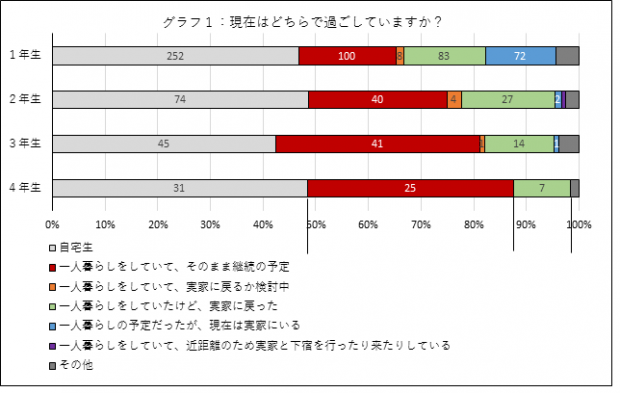
From now on, we will refer to them as follows: "Students at home": People who normally commute to school from home, "Students away from home": People who normally commute to school from a boarding house or other place other than home, "Residents at home": People who are currently living at home, including students at home and students away from home who are visiting their hometowns, and "Students living alone": Students away from home who are currently in Tokyo and not visiting their hometowns. Thank you for your understanding.
Return to Table of Contents
2.2 Tuition and income
As shown in Table 1, over 90% of students answered that their parents pay all of their tuition fees. However, 11% of students answered that they pay their tuition fees with one or more of the following: tuition exemptions, scholarships, or income from part-time work, indicating that they need to be careful about their financial situation.

Table 1: "How are you paying for your tuition?" Due to multiple responses, the totals of the columns exceed 100%.
Table 2 the results of a question about a "decrease in family income," a concern in this situation . 28% of students responded that their family income has decreased or decreased significantly. The percentage of families experiencing a decrease in income varied little by attributes such as grade level or commuting method, ranging from 27% to 30% across all attributes. What's particularly serious is that even among students who rely on tuition exemptions, scholarships, or part-time work income to cover their tuition, 28 students reported a decrease in their family income . These respondents are likely in a difficult situation, where their family income alone is already insufficient to cover their tuition fees, and the resulting decrease in income adds up.

Table 2: "To what extent do you think your household's 'family income' is likely to be affected by the spread of this infection?" This shows the total values for all grades. There was little difference even when narrowing down the data by grade or commuting method.
Graph 2 also shows the percentage of students working part-time. Naturally, the part-time work rate is overwhelmingly low among first-year students, less than 20% . While first-year students typically begin looking for part-time work once the new semester has settled down, this situation is likely to result in a large number of first-year students being unable to start part-time work. Table 3 asks about changes in part-time income, and nearly 70% of second- to fourth-year students who already have part-time jobs expect their income to decrease .
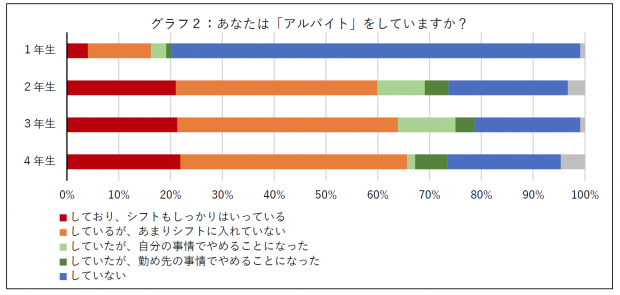
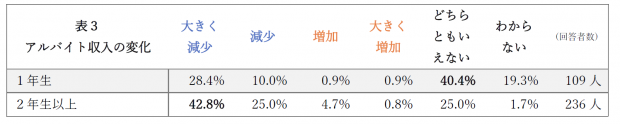
Table 3: "Please tell us about your part-time job income outlook."
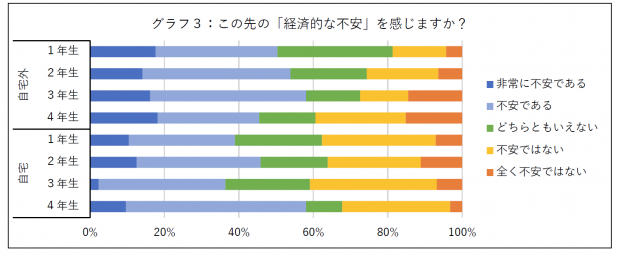
Graph 3 asks about future financial concerns. 47% of all respondents answered "very anxious" or "anxious." Among first through third year students, those living away from home appear to be feeling more anxious.
2.3 Classes and learning environment
As is well known, the University of Tokyo has decided to move all classes online. Table 4 shows the results of a survey asking students whether they use "on-demand" (using video materials) or "simultaneous interactive" (where students and faculty meet face-to-face in real time) . There does not appear to be any significant difference in class format between students of different grade levels.
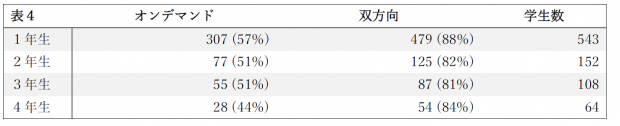
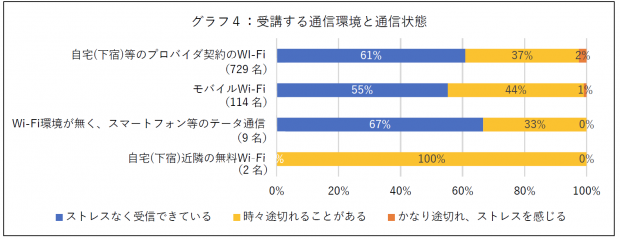
Table 4: "Please tell us about your current university classes." Due to multiple responses, the totals do not equal the actual number of students. Next are the results regarding students' communication environments. The percentage of students who can use Wi-Fi on fixed-line internet service providers is high among first- and second-year students, accounting for over 80% of the total. The figure is slightly lower among third- and fourth-year students, at over 70%. Mobile Wi-Fi accounts for 13% of the total. Graph 4 shows the relationship between the communication environment and communication status for classes. The graph shows that having a contract with an internet service provider does not necessarily mean the connection will be stable . A total of 21 students responded that "the connection is interrupted quite often, which is stressful .
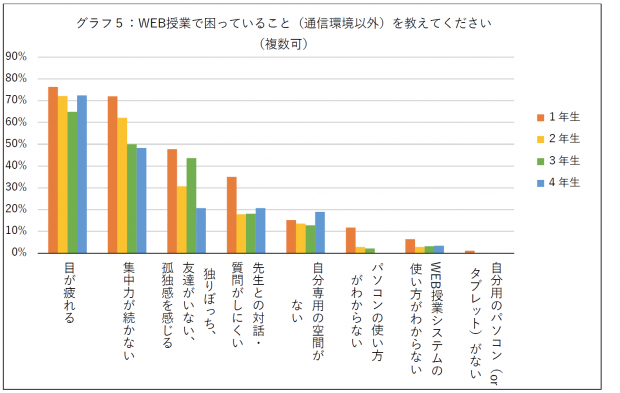
Graph 5 shows the results of a survey asking students about issues they face with online classes other than the internet connection. First-year students were the most dissatisfied . The percentage of students who felt "loneliness" was high not only among first-year students immediately after enrollment, but third-year students immediately after moving on to the senior division . The most prominent complaint among first-year students was "the lack of dialogue or questions with teachers," with a higher proportion of students who answered this question from outside their homes. Furthermore, just over 10% of students were dissatisfied with online classes due to the lack of their own dedicated space, and 90% of these students lived with their parents . This appears to be a serious problem, as it prevents students from securing a good learning environment due to constraints in their home environment (which are difficult to resolve due to family circumstances, etc.). Furthermore, dissatisfaction with "not knowing how to use a computer" and "not knowing how to use the online class system" was common among first-year students, suggesting that there is a segment of students who are using computers for the first time, are unfamiliar with them, and lack adequate support
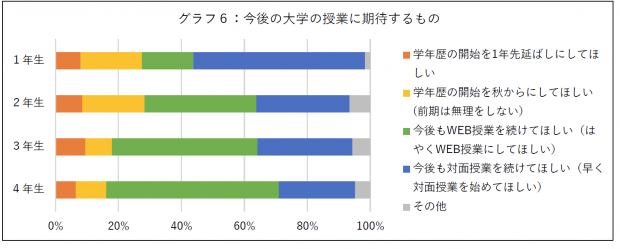
Graph 6 shows a question asking about expectations for future university classes. Many first-year students expressed a desire for face-to-face classes to begin sooner . However, as students progress through the grades, there is a tendency for more students to request that online classes continue. In another question, expressed a desire for measures such as delaying the start of the academic year
2.4 Club activities
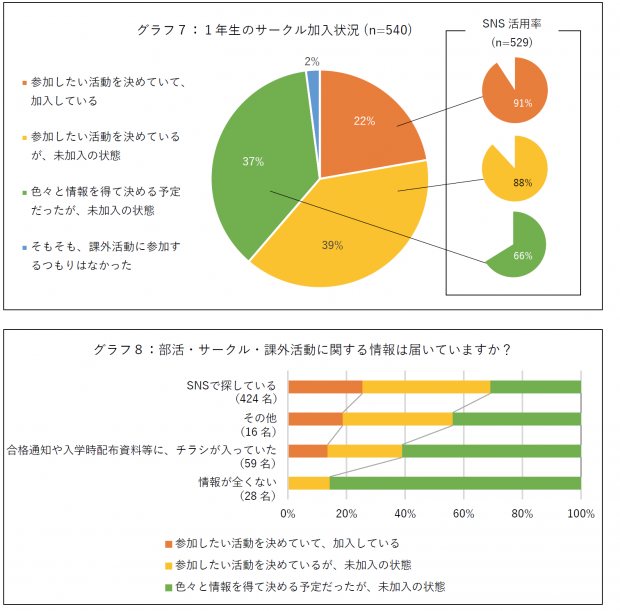
To the question, "Have you considered joining a club, circle, or extracurricular activity?", nearly all first-year students and approximately 20% of second- to fourth-year students responded. Based on this question, we investigated the club membership status of first-year students and the percentage of first-year students who obtain information through social media, as shown in Graph 7. Only 22% of first-year students have already joined a club , with the largest proportion (39%) of first-year students stating, "I've decided which activity I want to join, but I haven't joined yet." With in-person welcome events limited and club atmosphere difficult to gauge, it appears that many first-year students are hesitant to join. Furthermore, approximately 90% of first-year students who answered, "I've decided which activity I want to join," also said they use social media to find club information.
Graph 8 examines intentions to join clubs by information gathering method. While the overwhelming majority of first-year students are searching for clubs on social media, a significant proportion of first-year students who do not use social media and instead rely on materials distributed upon enrollment to find clubs are still undecided. This that social media plays an important role in choosing a club and deciding which one to join .
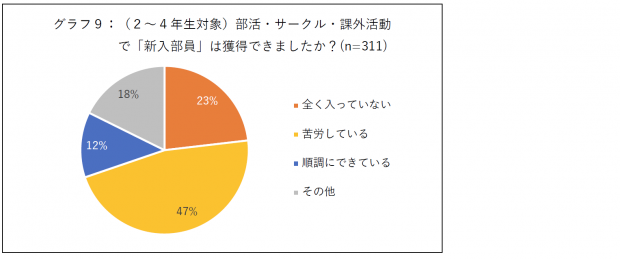
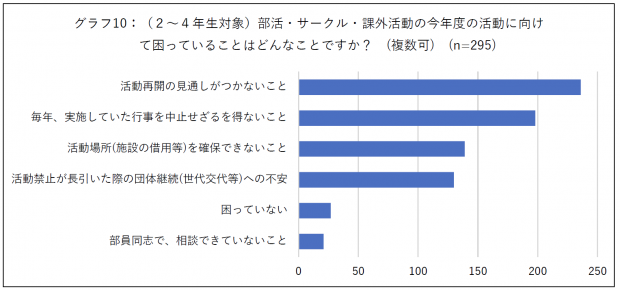
Graph 9 asks second to fourth year students about the recruitment of new members for clubs and other activities . responded that they are "struggling" to recruit new members for their clubs or that they have "no new members at all." Graph 10 asks about the outlook for clubs and other activities in the future.
2.5 Advisers and friends
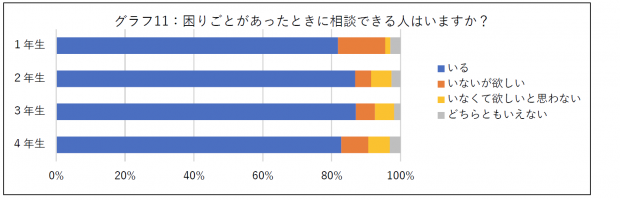
Graph 11 asks whether students have someone they can talk to about their problems. Regardless of year, over 80% of students answered that they "have" someone to talk to , but first-year students are particularly likely to say "I don't have someone, but I wish I did." Furthermore, when we looked at differences based on current living arrangements (living with parents vs. living alone) for first- to third-year students, who have a large sample size, we found that the percentage of first- and third-year students living alone who answered that they "have someone to talk to" was around 6% lower than those living with parents.
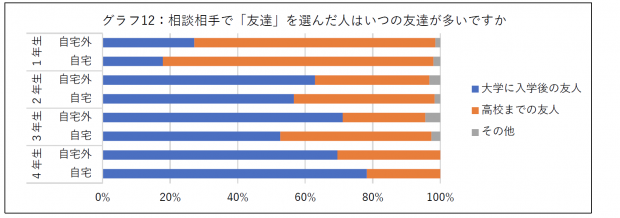
Graph 12 asks who they can talk to about their problems. 76% of first-year students say that their main person to talk to is a friend from high school , and the percentage of students who live at home who answer "friends from high school" is higher.
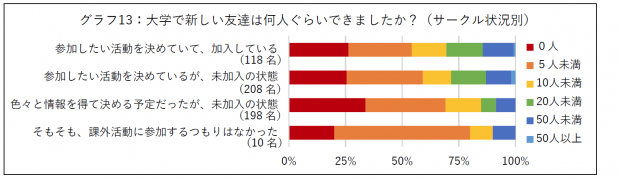
Graph 13 analyzes the formation of new friendships by club membership status among first-year students. First, the number of new friends is unprecedented: 29% of all first-year students have "0 friends," and 34% have "less than five . The fewer new friendships students have, the more likely they are to have not yet decided on a club . There was no clear relationship between friendships and living arrangements.
2.6 Diet
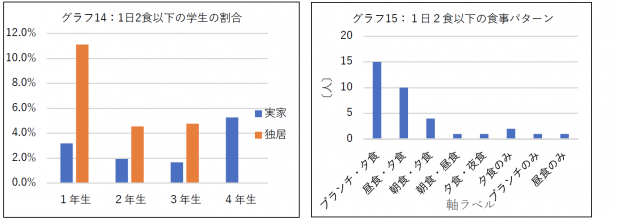
Graph 14 shows the percentage of people who do not eat three meals a day, based on a survey of the number of meals they eat per day . Compared to those who live with their parents, people who currently live alone tend to skip meals, with around 10% of first-year students living alone apparently eating two meals or less per day Graph 15 also analyzes the eating patterns of students who eat two meals or less per day . the majority skip breakfast and combine it with lunch only (first-year female, at home) .
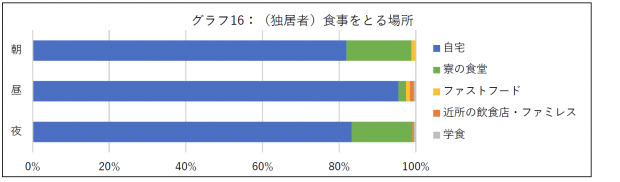
In addition, when asked where they eat breakfast, lunch, and dinner, 99.5% of people who live with their parents answered "at home," while for those who live alone, Graph 16 , approximately 85% answered "at home," and approximately 14% answered "at the dormitory cafeteria."
Next, we will consider changes in the dining environment due to the COVID-19 pandemic. First, we will analyze the responses of second- to fourth-year students who are accustomed to university life.
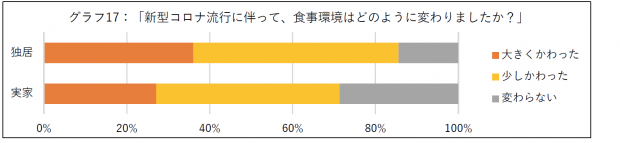
Graph 17 shows that many second- to fourth-year students, responded that their dining environment has changed "bigly" or "slightly."
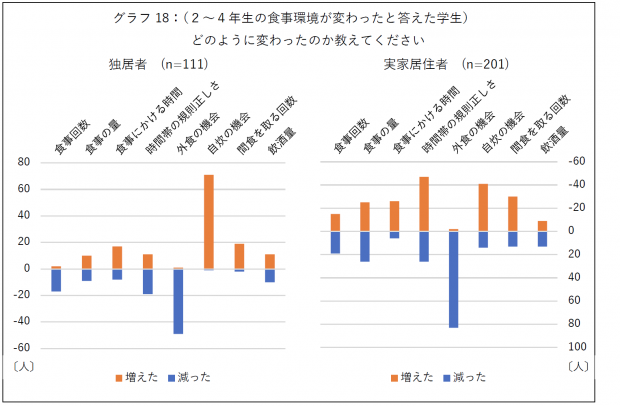
Graph 18 shows the specific changes that have occurred when second to fourth year students who answered that their eating environment has changed are asked about them. Regardless of living arrangements, opportunities to eat out have decreased significantly. For those living alone, opportunities to cook at home have increased significantly, but there is some evidence that the number of meals eaten has decreased and meal times have become somewhat irregular. For those living with their parents, the amount of time spent eating has increased and meal times have become more regular . This may be due to the fact that commuting time has decreased and students are now able to eat at a more leisurely pace.
For first-year students, April is a time when their eating environment changes significantly as they move on to higher education, even under normal circumstances without COVID-19. Since it is difficult to determine the extent to which COVID-19 has had an impact, we have not provided a graph. The trends are roughly the same as for second- to fourth-year students, but those living alone tend to cook more at home and eat less, which is somewhat more noticeable than for older students .
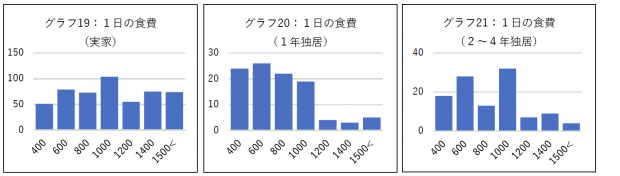
Graphs 19 to 21 examine food expenses . For those living with their parents, there is almost no difference in food expenses between grade levels, while for those living alone, there is a large difference in the distribution of food expenses between first-year students and second- to fourth-year students . First-year students tend to have lower food expenses, while for second-year students and above, food expenses are divided into two peaks.
2.7 Future Outlook
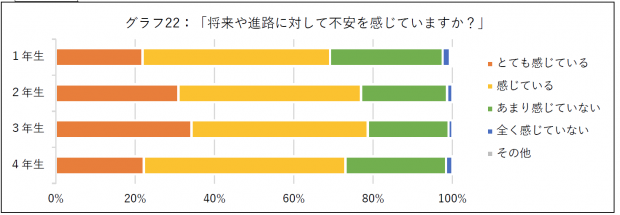
Graph 22 asks about concerns about the future, and 70-80% of students, regardless of year, feel anxious.
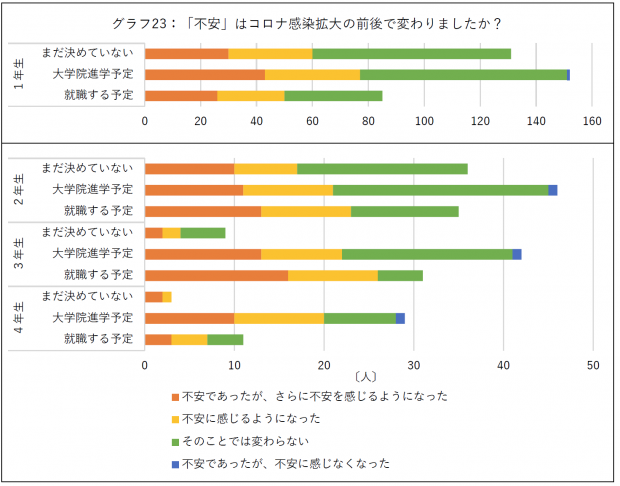
Graph 23 shows students who answered "very anxious" or "feeling anxious" being asked whether their anxiety has changed before and after the spread of COVID-19, broken down by desired career path. Many first- and second-year students have not yet decided on their career path, but among first- to third-year students, those planning to enter the workforce appear to be more likely to say that "COVID-19 has caused/increased anxiety ." Meanwhile , among fourth-year students planning to enter graduate school, a significant number have become more anxious . It is safe to assume that the uncertainty surrounding the future of job hunting and graduate school entrance exams is exacerbating anxiety in both cases.
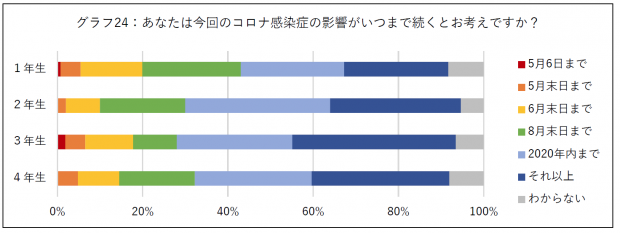
Graph 24 also shows students' outlook for the future situation . Nearly 60% of students expect the impact to continue into 2020 or beyond , and there is no clear outlook for when normal classes will resume in the A semester and when daily life will return to normal. Many first-year and fourth-year students expect the situation to be resolved quickly, but this may be wishful thinking due to the fact that they have just enrolled and are close to graduating, respectively.
In this situation, we asked the question, "To those currently job-hunting and those aiming to go to graduate school, what are you struggling with due to the impact of COVID-19? (Free-form answer)." In response to this question, we received responses such as: - The dates and format of graduate school entrance exams are unclear. Also, I can't take the qualification exams required for applying to graduate school. (8 responses)
- I can't do my graduation research, so I'm worried about my thesis. (3 responses)
- The dates for job hunting have been postponed, making the already confusing idea of finding a job even more confusing. (3 responses)
.
(2 responses) Return to Table
2.8 Concerns about student life
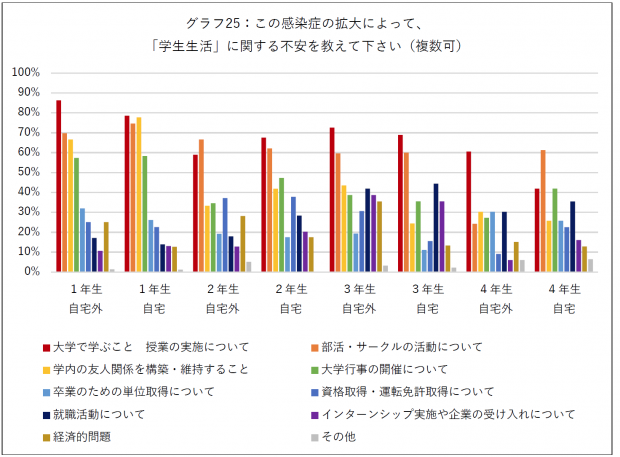
Graph 25 asks about concerns about student life. Because there was little difference in response trends based on current living arrangements (at home vs. living alone), the results are shown by normal commuting arrangements (living at home vs. living away from home) and by grade level. Across all grade levels, the greatest concerns were about studying at university, taking classes, and participating in club activities. Among first-year students, these were followed by "maintaining and building friendships on campus ." Concerns about university events were particularly strong among first-year students, likely reflecting the lingering effects of the cancellation of all events, from freshman orientation to the May Festival. Second-year students also expressed greater concerns about obtaining qualifications and driver's licenses Third- and fourth-year students reported more concerns about job hunting and internships , with 40% of third-year students (almost all those seeking employment) expressing concern about job hunting. Importantly, approximately 25-40% of first- to third-year students living away from home cited "financial issues," indicating the potential for financial problems depending on the length of this stay.
We will look at specific concerns in more detail in the next section, "Free Comments."
Return to Table of Contents
2.9 Free writing
shows a diagram of " co-occurring keywords (words that appear in a sentence with similar patterns of appearance)" extracted from responses to the open-ended question, "To those currently job-hunting and those aiming to go to graduate school, what are you struggling with due to the impact of COVID-19? " (38 valid responses) .
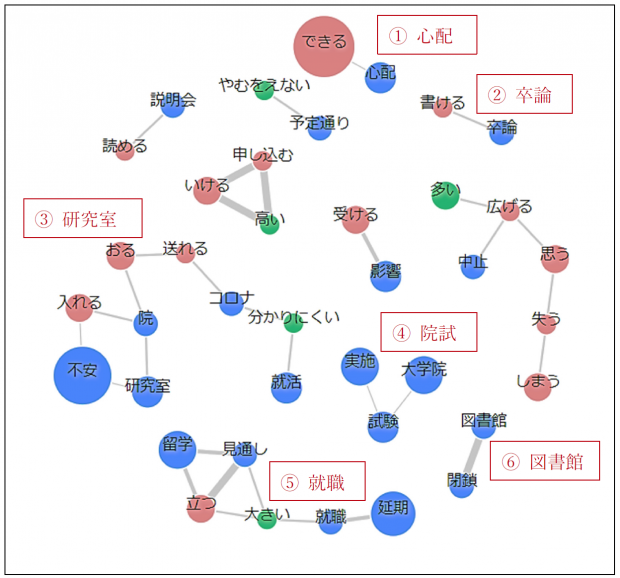
Figure 1: Analysis of co-occurring keywords from free responses asking about "problems with job hunting and entering graduate school"
Frequently mentioned keywords fell into six broad categories, and as introduced in 2.7, many voiced concerns about the uncertain outlook in the areas of graduation thesis, research lab, graduate school entrance exams Many also expressed their wish that libraries had not been closed Notable opinions were those concerned about the loss of a place to study and research, and the disparity in book purchases, and therefore learning, depending on economic ability Figure 2 illustrates co-occurring keywords extracted from the free response question, Finally, please tell us anything you think about your current university life (116 valid responses). "
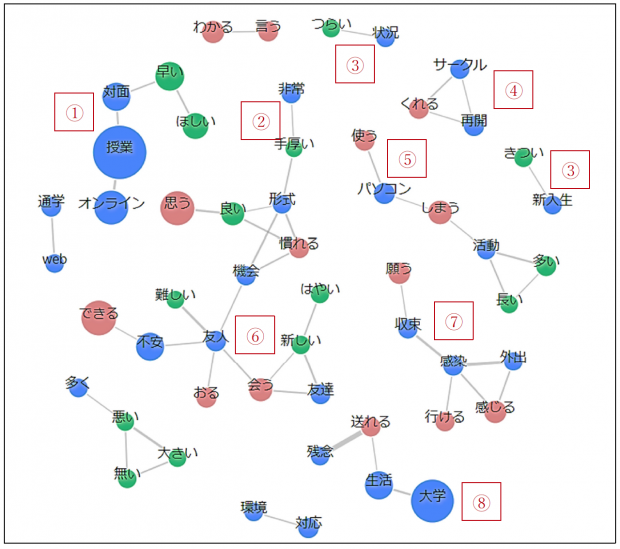
Figure 2: Analysis of co-occurring keywords in free responses to the question, "What are your thoughts about your current university life?"
We will broadly divide the results into eight clusters, ① through ⑧, to see which clusters make sense.
Cluster ① indicates that a significant number of opinions were received regarding online classes. Particularly notable were the voices calling for the early resumption of face-to-face classes, almost all of which were from first-year students . Meanwhile, several responses, primarily from fourth-year students, expressed a desire for online classes to continue, with comments such as, "Online classes have their advantages, and I've gotten used to them," "Online is more productive," and "I don't want to go even if face-to-face classes resume .
" Cluster ② represents impressions of the university's support, with some praising the university's support, such as, "It's very difficult to stare at a screen constantly, but the university provides generous support .
Cluster ③ directly expresses the distress of the current situation. "Because classes are now online, it's difficult to make friends, and when I don't understand something in class, there's no one to ask casually or for any other reason, so I'm very worried about whether I'll be able to keep up with the classes or get the credits . I'm also overwhelmed with assignments, which is mentally very tough (1st year female, living alone)," "I don't feel like a university student at all (omitted) My life is disorganized, I can't concentrate on classes, and I just spend my days aimlessly , so if this continues, it will have a big impact on my ability to get credits. The act of going to school itself is a big part of adjusting my daily rhythm, so if this lifestyle continues it will have a negative impact on my mental health. The current situation, where I'm responsible for everything, whether it's getting information incorrectly or not understanding the content of classes, is very difficult . I want a system that allows me to share tasks with others (1st year male, living at home)," and other such comments express strong concerns about not being able to discuss or share information about my studies.
4) Question 4 is about clubs. Upperclassmen expressed concerns about the continuation of club activities, saying, "It's depressing just thinking about when club activities and in-person welcome events will be allowed back, and how many new members will be fewer than usual," and "Even if they resume, I'm worried about how many people will want to join again." Others said, " I want to know how new students are thinking about choosing a club or circle, and whether they plan to wait until after the pandemic is over ." There may be a need for a forum where upperclassmen can understand the situation of new students. First-year students also expressed frustration with online fatigue and insufficient club information, saying, "I'm tired of the online format and don't want to participate in the online welcome events, but I'm worried I'll be left behind if I don't," and "Information about club information sessions is mainly distributed on Twitter, but some groups have already closed membership . I wish
Item 5 is a comment primarily about computer use, mainly from first-year students. Some comments include, "Once I use a computer, I quickly end up spending all my time on social media or surfing the web, and I miss half the lecture," "Being constantly on the computer blurs the line between play and study," and "It's hard to hear the professor's voice when it's audio-only. Without others watching, I lose focus, so I end up opening different tabs on my computer, and the guilt I feel causes stress." For new students who have just enrolled and are not accustomed to using computers for study or long periods of time, the sudden shift to online learning seems to be causing significant stress.
Question 6 concerns building friendships. Many students,
especially those living away from home, have expressed concerns about interpersonal relationships, saying, " I don't get to meet my friends or get to know my seniors, so it's difficult to get information about classes and other things, " and " I came to school from the countryside, so I don't have any friends in Tokyo I don't have any opportunities to meet or actively talk with my classmates face-to-face, so I'm worried I'll end up alone at university." Students living at home have also expressed concerns, saying, "I've given up on building normal friendships until the COVID-19 pandemic is over," and many have expressed the straightforward desire to have friends , regardless of their living arrangements. These highlight the harsh reality that building friendships is nearly impossible .
7) lamented the spread of the infection, expressing frustration toward society with comments such as, "It's unfair that only students can't go to school," and "I want people who are justifying their own outings and delaying the end of the infection to know that their actions are causing trouble for others." On the other hand, there were also comments such as, "A different approach to face-to-face classes is stimulating and has its own positive aspects (1st year, living alone)," and "I probably won't have many opportunities to stay at home like this, so I want to enjoy it while I can! (1st year, living at home)."
Finally, 8) was about university life. Many first-year students expressed regret over missing out on the normal university life, saying things like, "I don't feel like this is university life," "I'm really disappointed that I'm not living the university life I expected," "I want to live a normal university life," and "I was looking forward to and longing for what was supposed to be university life is difficult. Others expressed a desire for a delay in the new semester's events and the start of classes, saying, "I'd like the start of classes to be changed to September at the very least. Selfishly, I'd like it to be delayed by a year. There's a chance I'll graduate without having the college experience I'd imagined, and I might not be able to study abroad. I understand there are circumstances, but I hope they'll understand my feelings and make the best decision possible." "If it's possible to enroll in the fall semester, I sincerely hope so, and I'd be happiest if we could recreate as much of the normal life as possible, starting with the entrance ceremony ." One first-year student described the current situation as "there's nothing symbolic of college life left."
Finally, I'd like to conclude with a comment from one respondent.
Changes are occurring not only in college life but in society as well, and I feel it's significant that various online initiatives have been institutionalized and implemented at universities with a mandatory force. However, with the future still uncertain, there are many interpersonal issues, such as problems that cannot be resolved by online learning or that the university itself cannot do anything about. I hope that the University Co-op will play a part in solving these problems and provide what only the Co-op can do.
End
