



Interview with a University of Tokyo graduate working at a publishing company Vol.3 Seidosha Y-
san
Release date: February 28, 2026
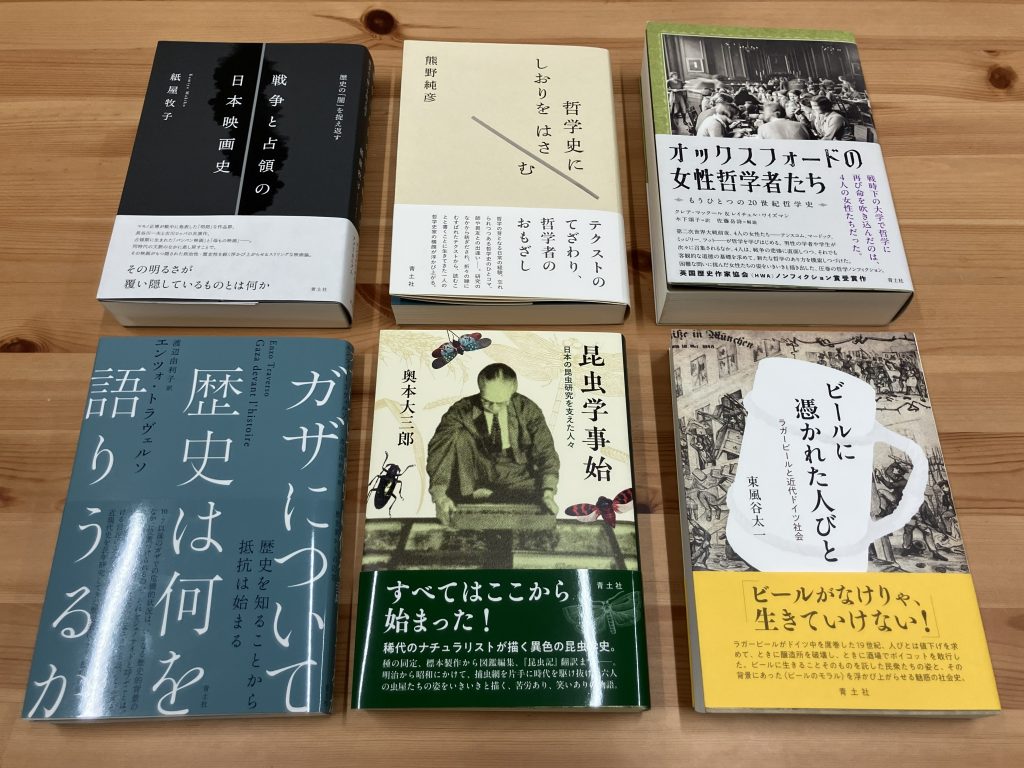
The photo above shows some of the books that Mr. Y was in charge of in 2025. As can be seen in the answer, there is a wide range of fields covered by each person in charge
■Name
Y
■Faculty and major at the time of enrollment at the University of Tokyo
Graduated from the Faculty of Letters in 2021
■Currently employed publisher
Seidosha Co., Ltd.
Website: https://www.seidosha.co.jp
■How I spent my university days
During my first and second years at Komaba, I went to talk to a lot of different people as part of activities such as a newspaper club and an independent seminar that involved fieldwork. After I decided to enter the Faculty of Letters, I remember spending a lot of time in the university library, poring over a dictionary and reading original books on philosophy.
■My involvement with books and the Co-op Bookstore during my university days
During high school, I was so busy studying for entrance exams that I hardly had time to read any books. Perhaps as a reaction to that, after entering university, I spent all my time reading humanities books, especially those related to philosophy and thought. I regret it now, but I was so busy with classes and class preparations on weekdays that I didn't have much time to drop by the Co-op Bookstore. They helped me buy textbooks and order books.
■Reason for choosing the publishing industry
I have been interested in newspapers and other paper media since I was in elementary school, but I was particularly influenced by the paperbacks aimed at junior and senior high school students that I read when I was in junior high school (such as Chikuma Primer Shinsho and Iwanami Junior Shinsho). I was attracted to the idea of delivering the thoughts of leading researchers in a format that the general reader could understand.
■What kind of work do you do?
Seidosha publishes two monthly magazines, "Gendai Shiso" and "Eureka," as well as books (mainly humanities books). The editorial department is divided into three accordingly, and I belong to the book editorial department. In editing, I am involved in every process, from coming up with a plan to actually taking the form of a book. I fill in the contents of the book through meetings with authors and translators and proofreading galleys (trial prints with the actual type in type), and at the same time, I work with book designers, printing companies, and paper distributors to ensure that the book comes to fruition.
■Characteristics and attractions of the publishing company I work forFrom
what I've heard from other publishers, I think one of the characteristics is that there is a high ratio of employees in their 20s and 30s.The theme to choose, which author to ask, and other aspects are largely left to each employee's discretion, so I feel that it is an environment where you can create books and magazines based on your own interests.
■My impressions of working in the publishing industry
It goes without saying that a book exists because of the writer, but publishing is more of a "production" process than I had imagined. In addition to "writing," a book takes shape and reaches your hands through various processes such as "compilation," "assembly," "packaging," "printing," "transportation," and "selling." At larger companies, work that would be handled by the production department is handled by employees in the editorial department at Seidosha. This means there is more work to do, but I think one of the benefits is being able to work while having the real feeling that you are "making" a book.
■ The rewards and joys of the job
Each book I'm in charge of is in a completely different field, such as film, history, or psychology, so I learn something new each time. When I was a student, I only read books related to my specialty, so when I first joined the company, I felt like I was stretching muscles that I don't normally use. Now I think that it's actually become a source of enjoyment, and sometimes I come across topics that I want to delve deeper into. After a book is actually published, as reviews come out and I talk to readers, I sometimes realize that it's being read in ways I'd never expected, and I think that's another fun part of the job.
■Recommended products from our company and why:
We've selected books edited by other employees working in the same book editorial department.
Hyodo Hiroki, "Story Tradition Theory," Seidosha, 2025.
When you hear the term "biwa hoshi," many people probably think of a historical figure. In fact, storytelling traditions by blind monks remained in the Kyushu region until the end of the 20th century, and Hyodo energetically conducted field research and recorded them during the final period of that era. This book is a major work that builds on that experience to launch a grand literary history of "voice." Ever since I first saw the proposal in a meeting, I've been looking forward to its publication.
Aaron Parzanowski, "The Right to Repair: Towards the Freedom to Continue Using," translated by Nobuyasu Nishimura, Seidosha, 2025.
Have you ever had the experience of breaking your smartphone, trying to fix it yourself but being unable to, and having to pay a lot of money to buy a new one? Reading this book reveals the reality that companies are cleverly taking away the "right to repair," from individual devices to equipment used in medical and agricultural fields. This book connects your own frustrations with the distortions in society as a whole.
Nobuyuki Kakinoki, "Benjamin: Thoughts that Survive after Catastrophe," Seidosha, 2025.
Benjamin was a German thinker who lived through an era of war and fascism. This book is written by Kakinoki himself, continuing to walk the path that Benjamin walked. In announcing the publication of this book, Kakinoki recalled Derrida's words, "To live is to survive." Kakinoki's own journey reading Benjamin reveals what it means to live with the dead.
■The latest trend in the publishing industry
can be summed up in one word: "first-person narrative." My impression is that books that allow the reader to identify with the "I" who researches and writes about them, whether they be literary works or humanities books, are widely popular. On the other hand, fewer people than before read books with the motivation of "learning" something for their own cultural gain. I've heard from an acquaintance of mine at another company that the main readership for paperbacks is now in their 70s, and that they're struggling to find younger readers.
Yoko Hondawada's "Practikantin" (Trainee) by Chuokoron-Shinsha, 2025, is
a must-read for Tokyo University students. This book is intended for a wide audience, not just those at the University of Tokyo. It's a selection of books I read in 2025. The book recounts the daily life of a "person" who graduates from university and works as a trainee at a German book distributor, likely based on Tawada's own experiences.
The following casually placed passage is particularly striking: "Is there anything that happened this year that I want to forget? I feel like I want to preserve everything, even the unpleasant things."
While many things happen during university, this book reminds us that there is a place for not only the good things, but also the smallest thoughts and incomprehensible events.
■Message to Tokyo University students
The publishing industry, or at least the humanities book industry, is not in a good state, and this is manifesting itself in various distortions on the front lines. Despite this, I can confidently say that it is a blessed job that allows you to constantly make new encounters with people and society through books as a medium. I think it would be wonderful if there is an opportunity in the future to work together in the same industry with those who have read this article.
<end>
A list of articles is posted on this page
○Planning and Management: Komaba Book Club, University of Tokyo Co-op
If you have any inquiries or comments about this project, please send them to us using this form
